Bootstrapping vs Funding: What's Best for Your Startup?
Decision framework for choosing between self-funded and investor-backed growth.
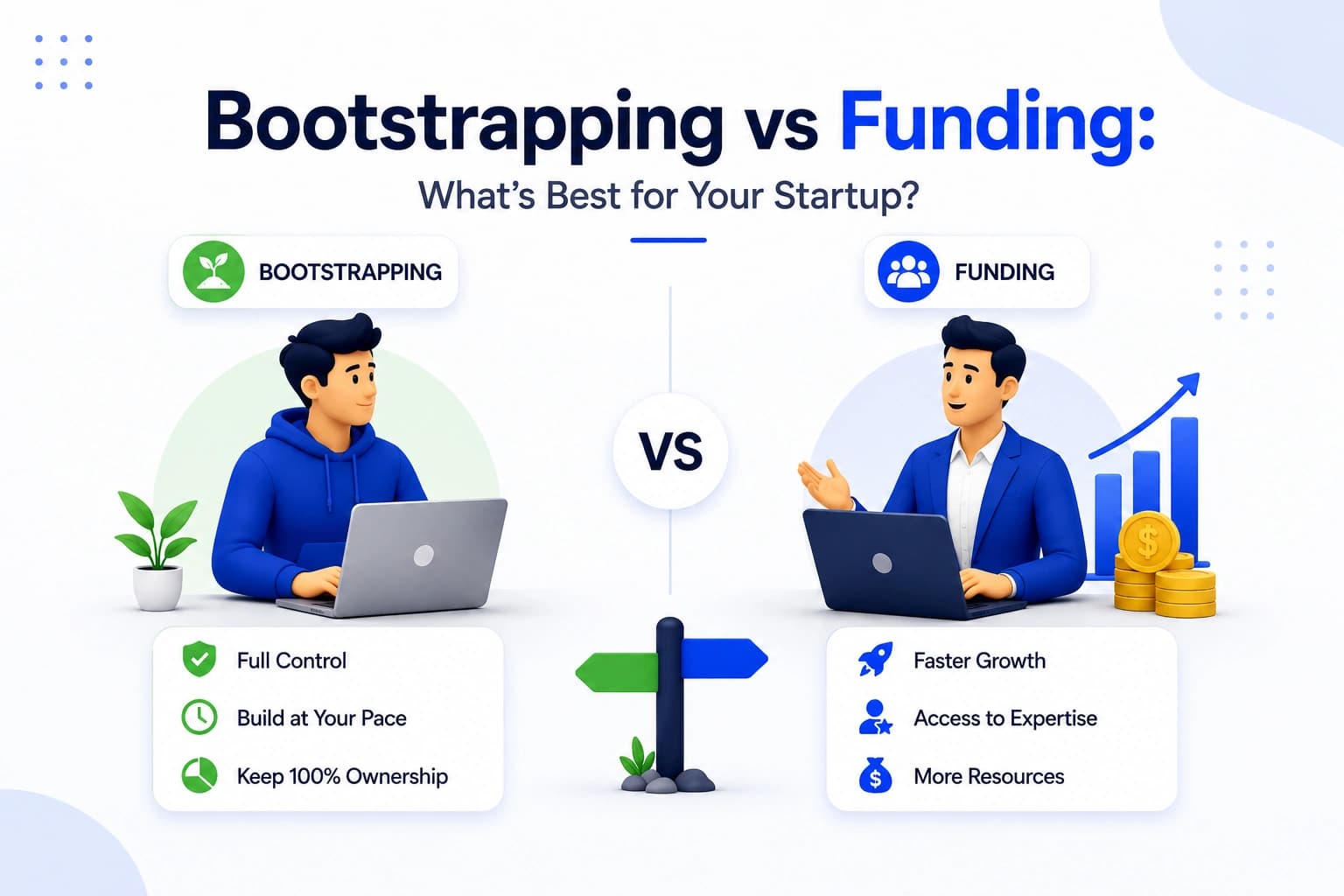
Key takeaway:Bootstrapping provides ultimate founder control and profitability but limits scale, whereas VC funding injects massive growth capital at the cost of equity dilution and a "grow or die" mandate.
Target Audience & Use Case: Ideal for early-stage startup founders evaluating financing options, analyzing TAM, or deciding whether to self-fund or seek angel/VC investment.
According to Harvard Business Review, one of the most consequential decisions a founder will make is how to finance their startup. The choice between bootstrapping (self-funding) and raising venture capital (funding) dictates not just how fast you grow, but the very nature of the business you are building.
Bootstrapping gives you ultimate control and forces financial discipline, but it can limit your speed. Venture capital acts as rocket fuel, enabling aggressive expansion and talent acquisition, but it comes with immense pressure, dilution of ownership, and the expectation of a massive exit.
There is no universally "correct" path. The right choice depends entirely on your market dynamics, your business model, and your personal goals as a founder.
This guide provides a pragmatic framework to help you evaluate which financial engine is the right fit for your startup's current stage and future ambitions.
The Core Trade-offs
Control vs Speed
Bootstrapping means you answer only to yourself and your customers, keeping 100% of the equity. Funding trades equity and board seats for the capital needed to outpace competitors and capture market share quickly.
Risk Allocation
When you bootstrap, the financial risk is entirely on your shoulders. When you raise VC, the financial risk is shifted to investors, but the operational risk (the pressure to achieve 10x growth or bust) skyrockets.
Founder Economics
A bootstrapped founder can achieve life-changing wealth from a $10M exit. A VC-backed founder might see nothing from a $20M exit due to liquidation preferences if they raised too much capital at high valuations.
When bootstrapping fits
Your business model generates cash quickly. SaaS, agencies, or services businesses where customers pay upfront are ideal for bootstrapping because revenue funds the next stage of growth.
You are operating in a niche market. If your Total Addressable Market (TAM) is $50M, VCs won't be interested because it can't return their fund. Bootstrapping allows you to dominate a niche profitably.
You prioritize optionality and control. If you want the freedom to grow at your own pace, build a lifestyle business, or sell the company on your own terms without investor pressure, self-funding is the way.
When raising fits
It's a "winner-take-all" market. If you are building a marketplace, a social network, or an infrastructure play where the first to scale wins a monopoly, speed is survival. Capital buys that speed.
High upfront capital expenditures (CapEx). Deep tech, hardware, biotech, or AI models requiring massive compute cannot be bootstrapped. You need capital to build the product before generating a single dollar of revenue.
You want to build a billion-dollar company. If your ambition is to go public or create a generational tech giant, the networks, talent acquisition power, and sheer capital of top-tier VCs are often necessary.
Hybrid paths
Bootstrap to Series A. Many modern founders self-fund or use revenue to reach $1M-$2M ARR before raising. This minimizes early dilution and gives you massive leverage during term sheet negotiations.
Raise angels, then bootstrap. Taking a small amount of angel money ($100k-$500k) from strategic operators can help you quit your job and build the MVP, after which you shift to a profitability focus rather than the VC treadmill.
Venture Debt or Revenue-Based Financing. If you have predictable revenue but want to avoid equity dilution, modern funding tools allow you to borrow against future subscriptions to fund marketing or inventory.
Operating differences
Cash Flow vs Growth: Bootstrapped companies obsess over gross margins, profitability, and positive cash flow. Funded companies obsess over top-line revenue growth, market share, and Month-over-Month (MoM) expansion.
Hiring: Bootstrappers hire slowly, focusing on generalists who can wear multiple hats. Funded startups hire aggressively, bringing in expensive specialists and executives to scale specific departments rapidly.
Decision Making: Funded founders spend 20-30% of their time managing board relations, reporting metrics, and preparing for the next fundraise. Bootstrapped founders spend 100% of their time on the product and customers.
Making the call
Evaluate your market size honestly. If your ceiling is $10M a year in revenue, do not take VC money. It will misalign your outcomes and investors will push you to take unnatural risks.
Look at your personal risk tolerance. Are you willing to lose 100% of your personal savings? Are you willing to be replaced as CEO if the board decides you aren't scaling fast enough?
Ultimately, optimize for alignment. The worst outcome is building a great $20M business with investors who expected a $1B business. Match your funding strategy to your actual business mechanics.
◆ Execution blueprint
Framework to decide your capitalization strategy.
| Phase | Goal | Output | Timeline |
|---|---|---|---|
| Assess | Define personal goals | Founder alignment doc | Day 1 |
| Market Sizing | Calculate TAM | VC-viability check | Week 1 |
| Economics | Map cash cycle | CapEx & Margin analysis | Week 2 |
| Decide | Choose primary path | Cap table structure | Month 1 |
| Execute | Scale or Pitch | Profit OR Term sheet | Ongoing |
Reference table
| Metric | Bootstrapped | Funded (VC) |
|---|---|---|
| Primary Focus | Profitability & Cash Flow | Growth Rate & Market Share |
| Growth Trajectory | Linear & Predictable | Exponential (J-Curve) |
| Founder Control | 100% Autonomy | Board oversight & Dilution |
| Risk Profile | Personal financial risk | Market risk / "Grow or Die" |
| Exit Expectations | Flexible (Hold, small exit) | 10x return or bust (IPO/M&A) |
Key points
- Funding is a tool, not an accomplishment.
- Bootstrapping forces you to build a real business from day one.
- VC money changes the DNA of your company permanently.
- High capital requirements (Hardware/AI) dictate funding.
- Niche B2B SaaS is often best bootstrapped initially.
- Raising money means you are committing to a large exit.
- You can bootstrap first and raise later for better terms.
- It is very hard to go from funded back to bootstrapped.
- Venture debt is an option, but requires stable cash flow.
- Align your funding choice with your personal life goals.
Action checklist
- Calculate your exact monthly personal burn rate
- Estimate the initial CapEx to build the MVP
- Map out your Total Addressable Market (TAM)
- Identify if the market is 'winner-take-all'
- Discuss alignment and risk tolerance with co-founders
- Review alternative financing (Grants, Revenue-based financing)
- Model cash flow for the next 12 months
- Decide if you are optimizing for control or scale
- Create a bootstrap 'kill switch' metric
- Draft a pitch deck ONLY if VC path is chosen
Frequently asked questions
Quick answers to what founders usually ask about capitalization.
Are bootstrapped startups always slower?
Not necessarily in the beginning. Bootstrapped teams are often faster to find true product-market fit because they aren't distracted by board meetings and bloated teams. However, once fit is found, funded startups can deploy capital to capture the market much faster than a company relying solely on organic revenue.
Not necessarily in the beginning. Bootstrapped teams are often faster to find true product-market fit because they aren't distracted by board meetings and bloated teams. However, once fit is found, funded startups can deploy capital to capture the market much faster than a company relying solely on organic revenue.
Do angel investors dilute control like VCs?
Usually, no. Angels typically write smaller checks ($10k-$100k) and do not demand board seats or complex control terms. They are often former founders themselves, making angel money a great 'hybrid' step before traditional venture capital.
What if I raise money and then want to pivot?
Pivoting is incredibly common in early-stage funded startups (Seed/Pre-Seed). Good investors invest in the team, not just the initial idea. As long as you communicate transparently and pivot into a market with similar venture-scale potential, investors will usually support it.
Is venture debt a good idea for early-stage?
No. Venture debt requires predictable, recurring revenue to service the loan. Early-stage startups lack this predictability. Venture debt is best used later (Series B+) to extend runway between equity rounds without further dilution.
Can MYSTARTUPWAVE help prepare for funding?
Yes. We help founders build scalable MVP architectures, establish solid early-stage growth metrics, and prepare the technical due diligence necessary to close Seed and Series A rounds successfully.
Need implementation support?
MYSTARTUPWAVE helps founders and teams ship product, growth, and cloud delivery with clear milestones.