How to Build a Strong Brand Identity from Day One
Build a strong brand identity from day one with clear positioning, visual consistency, messaging clarity, and a founder-friendly system people remember.
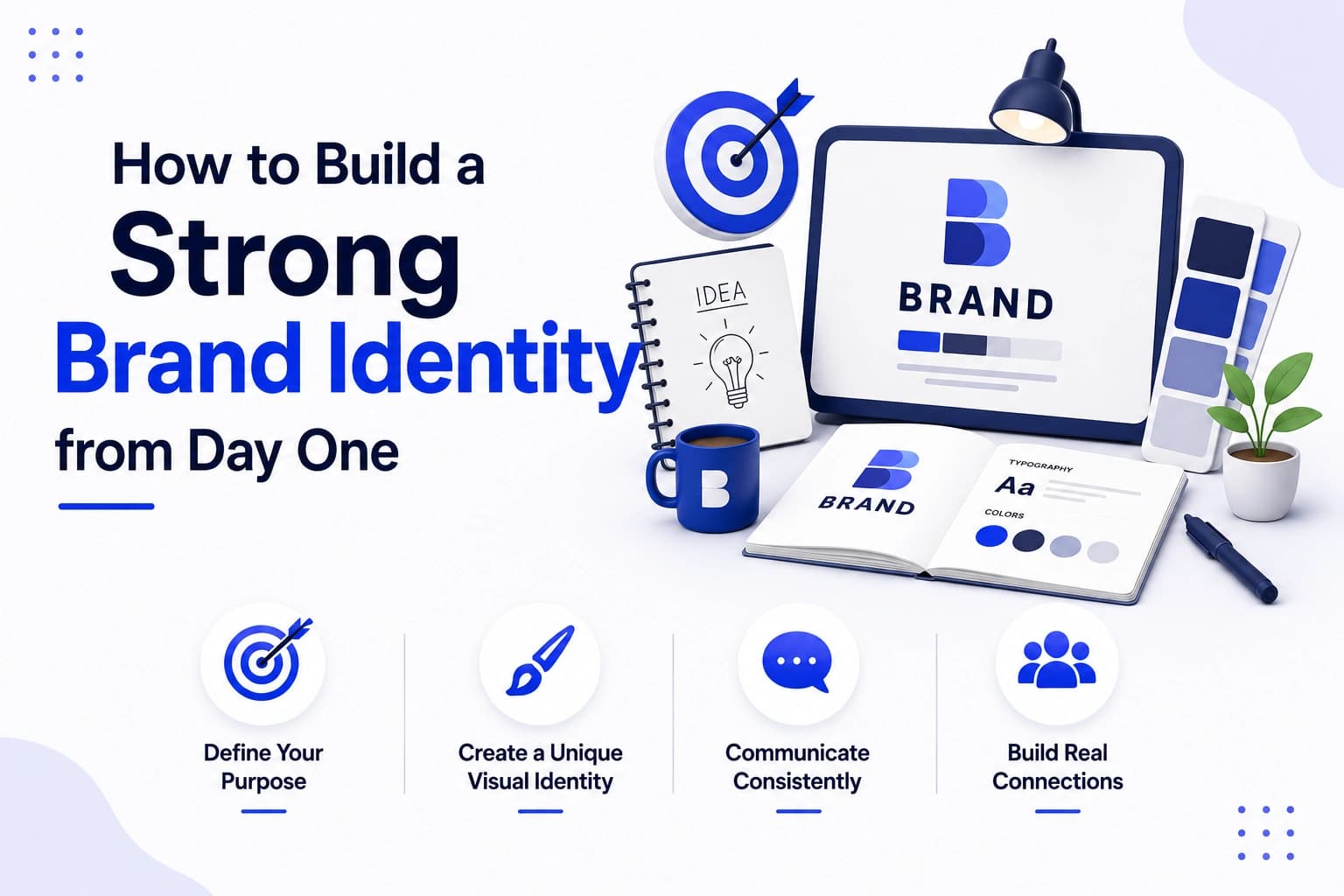
Key takeaway: Building a brand identity from day one is about consistency, verbal tone, and a strong core narrative rather than expensive visual assets. A Minimum Viable Brand (MVB) lowers CAC and boosts customer retention.
Target Audience & Use Case: Ideal for early-stage startup founders and founding marketers who need to establish a trusted, professional identity without a massive agency budget.
A strong brand is more than a logo. As highlighted by branding experts, a brand is the gut feeling people have when they interact with your company. In a crowded digital space, brand is often the only sustainable differentiator. It lowers customer acquisition costs, increases retention, and commands a price premium.
Many founders wait too long to think about brand, believing it is something to figure out "after product-market fit." But your brand is being formed from day one, whether you intentionally shape it or not. Every email you send, every support ticket you answer, and every UI button you place contributes to that identity.
This guide provides a pragmatic framework to build a minimum viable brand (MVB) that scales with your product without requiring a massive agency budget early on.
Brand Fundamentals
Founder-led
Your brand initially inherits the founder's personality. Do not hide behind a sterile, corporate facade too early. Authenticity builds trust faster than polish.
Consistency over creativity
Boring but consistent is better than creative but chaotic. Repetition of colors, fonts, and messaging builds necessary memory structures in your customers' minds.
Tone over visuals
How you speak to customers—your tone of voice—is often more memorable than your color palette. Words scale cheaper and faster than design assets.
Positioning and narrative
Write your brand narrative first. Why do you exist? Who is the "enemy" (the old, broken way of doing things)? What is the "promised land" you are taking users to?
Turn this narrative into a 1-sentence positioning statement: For [target audience], [Company] is the [category] that [core benefit] because [why you are different].
Ensure every team member can recite this narrative. It becomes the filter for every feature you build and campaign you run.
Verbal identity
Establish your tone of voice. Are you an authoritative expert, a rebellious challenger, or a helpful guide? Pick three adjectives to define your tone.
Document your vocabulary. Create a simple table of "Words we use" and "Words we ban." (e.g., We say "Team," we never say "Resources").
Apply this tone everywhere, especially in places people don't expect it: error messages, billing receipts, and password reset emails.
Visual system (minimum viable)
Pick one primary color and one secondary color. Don't overcomplicate palettes early on.
Select one highly legible font family. Use a maximum of two weights (e.g., Bold for headers, Regular for body).
Create a simple, text-based logomark. Early on, focus on a clean layout, negative space, and hierarchy rather than complex, expensive illustrations.
Product and experience alignment
Your brand breaks instantly if your marketing is playful and modern, but your actual product interface is confusing and outdated.
The product is the brand. Speed, reliability, and ease of use are brand attributes.
Customer support is the front line of your brand identity. How you handle a refund request leaves a longer-lasting impression than a clever billboard.
Scaling the brand without drift
As you hire freelancers and new employees, "brand drift" occurs naturally.
Create a one-page, easily accessible brand guideline document (a Notion page is fine).
Appoint one person (usually a founder early on) as the "Brand Guardian" to review public-facing assets before they ship.
◆ Execution blueprint
Phased timeline to establish your Minimum Viable Brand (MVB).
| Phase | Goal | Output | Timeline |
|---|---|---|---|
| Define | Core narrative | Positioning doc | Week 1 |
| Verbal | Tone & Voice | Copy guidelines | Week 2 |
| Visual | Visual identity | MVB asset pack | Week 3 |
| Apply | Update touchpoints | Website/App sync | Week 4 |
Reference table
| Metric | Focus Area |
|---|---|
| Brand Awareness | Share of voice & Direct Traffic |
| Brand Sentiment | NPS & Social listening |
| Visual Consistency | Internal audit score |
| Message Match | Ad-to-landing-page conversion |
Key points
- Brand is a feeling, not just a logo or color palette.
- A strong narrative drives emotional connection.
- Consistency beats cleverness every single time.
- Founder personality is a massive early-stage asset.
- Tone of voice is your cheapest, most scalable differentiator.
- Restrict your visual choices to maintain visual discipline.
- The product experience must match the marketing promise.
- Support interactions define your brand under pressure.
- Document rules early to prevent brand drift.
- Don't overspend on agencies before you have product-market fit.
Action checklist
- Write the 'enemy vs. hero' narrative
- Draft the 1-sentence positioning statement
- Pick exactly 2 primary brand colors (Hex codes)
- Select 1 highly legible font family
- Draft a 1-page tone-of-voice document
- List 5 'words we use' and 5 'words we ban'
- Audit all automated emails for tone consistency
- Update social media bios to match positioning
- Create a shared folder for logos and assets
- Appoint one founder as the 'Brand Guardian'
Frequently asked questions
Quick answers to what founders usually ask about branding.
Do I need a branding agency?
No, not on day one. A minimum viable brand (MVB) can be created in-house or with a solid freelance designer. Wait until you have solid revenue, proven product-market fit, and a clear understanding of your audience before spending $50k+ on a professional agency rebrand.
No, not on day one. A minimum viable brand (MVB) can be created in-house or with a solid freelance designer. Wait until you have solid revenue, proven product-market fit, and a clear understanding of your audience before spending $50k+ on a professional agency rebrand.
How do I measure brand ROI?
Brand ROI is notoriously hard to measure directly, but you can track proxy metrics. Look at the percentage of 'Direct Traffic' in Google Analytics, branded search volume, lower Customer Acquisition Cost (CAC) over time, and an increase in inbound 'warm' leads.
What happens if we pivot the product?
If your brand was built around a specific feature, a pivot will break it. This is why you should build your brand around a core philosophy or a specific target audience. If you change how you solve the problem (the product), the 'why' (the brand) remains intact.
Can founders have a separate personal brand?
Yes, and they should. The founder's personal brand acts as a top-of-funnel magnet for the company. While the company brand must remain professional and consistent, the founder's brand can be more vulnerable, opinionated, and dynamic to build trust quickly.
Can MYSTARTUPWAVE help design our brand?
Yes. We help startups define their core narrative, design their Minimum Viable Brand (logos, typography, color systems), and ensure that visual identity translates seamlessly into their SaaS UI and marketing landing pages.
Need implementation support?
MYSTARTUPWAVE helps founders and teams ship product, growth, and cloud delivery with clear milestones.