Building Scalable Web Apps: Tools & Frameworks You Need
Explore the tools and frameworks behind scalable web apps. Learn how to combine frontend performance, backend power, and database resilience.
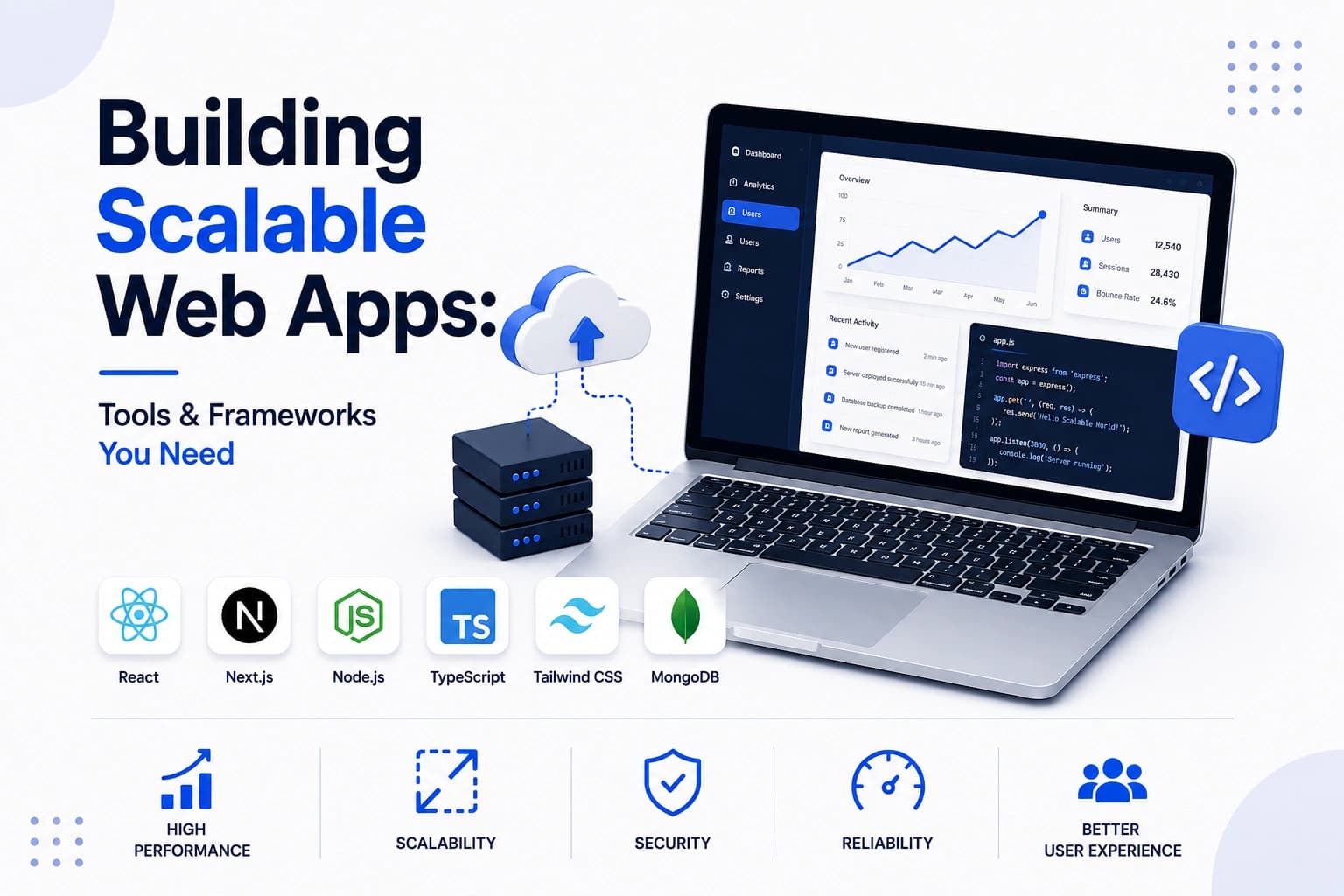
What is a scalable web app? A scalable web app is designed to seamlessly handle growing amounts of traffic and data without performance degradation by using decoupled architectures and resilient infrastructure.
Key takeaway: To build a truly scalable web application, you must adopt strict decoupling between your frontend and backend, enforce type safety (TypeScript), and leverage caching (Redis) alongside robust relational databases (PostgreSQL). Meta-frameworks like Next.js offer critical performance advantages right out of the box.
Target Audience & Use Case: Tailored for CTOs, lead developers, and engineering managers tasked with selecting the right web architecture to support their startup's next phase of hypergrowth in the software industry.
Building a web application that scales from its first 100 users to 100,000 requires more than just good code—it requires the right architectural decisions from day one. A fragmented or overly complex tech stack will create bottlenecks that slow down your entire team.
As noted in The State of JS report, modern web development is moving away from massive monoliths and towards decoupled, highly specialized architectures. Teams are opting for setups that offer exceptional developer experience (DX) while delivering blazing-fast performance to the end-user.
This guide breaks down the essential tools, frameworks, and rendering patterns you need to architect a robust, future-proof web application in 2026.
Architecture Principles
Reason before structure
Don't pick tools just because they are trending. Evaluate your actual data flow and user needs before committing to a framework.
Beyond basic SSR
Server-Side Rendering is standard, but scaling requires understanding when to use Static Site Generation (SSG) and edge caching.
APIs are the lifeblood
Treat your API as a primary product. A well-designed, strictly typed API ensures your frontend and backend scale independently without friction.
Which frontend frameworks should you use?
React remains the industry standard, but vanilla React is rarely enough. Meta-frameworks like Next.js provide the routing, SSR, and API layer needed for production apps.
Type safety is no longer optional. TypeScript is mandatory for scalable codebases, preventing thousands of runtime errors before the code even compiles.
Leverage Server Components. By rendering heavy components on the server, you ship significantly less JavaScript to the client, boosting Core Web Vitals.
How to architect APIs and backend patterns?
For high-performance backends, frameworks like FastAPI (Python) offer incredible speed and automatic interactive documentation, making integration seamless.
Ensure strict contracts between your frontend and backend using tools like tRPC or OpenAPI definitions.
Keep business logic out of your frontend components. The UI should only render data and capture interactions.
What are the best database and caching strategies?
Relational databases (PostgreSQL) are the safest default for structured data. Platforms like Supabase offer instant APIs and real-time subscriptions on top of Postgres.
As traffic grows, database queries become the bottleneck. Implement Redis to cache frequently accessed, rarely changing data.
Use connection pooling for serverless environments so you don't exhaust database connections during traffic spikes.
How to implement testing and quality assurance?
End-to-End (E2E) testing with Playwright or Cypress ensures your critical user journeys work exactly as expected in a real browser.
Don't aim for 100% unit test coverage immediately. Focus on testing complex business logic and utilities first.
Integrate automated testing directly into your pull request pipeline to block broken code.
What deployment platforms support observability?
Platforms like Vercel have revolutionized frontend delivery with global edge networks and instant rollbacks.
You cannot fix what you cannot see. Implement observability tools (like Sentry or Datadog) to track API latency and frontend crash reports.
Set up alerting for critical failures, but tune the noise down so your engineering team doesn't suffer from alert fatigue.
◆ Execution blueprint
Phased plan to implement a scalable architecture.
| Phase | Goal | Output | Timeline |
|---|---|---|---|
| Audit | Define data flow | Schema draft | Week 1 |
| Setup | Repo initialization | Monorepo / CI/CD | Week 2 |
| Backend | API endpoints | Swagger docs | Weeks 3-4 |
| Frontend | UI integration | Client app | Weeks 5-7 |
| Scale | Add caching | Redis layer | Month 3+ |
Reference table
| Layer | Top Choices |
|---|---|
| Frontend | Next.js, React, TailwindCSS |
| API | FastAPI, tRPC, GraphQL |
| Database | PostgreSQL, Supabase, MongoDB |
| State | Zustand, React Query |
| Observability | Sentry, Datadog, LogRocket |
Key points
- TypeScript is non-negotiable for modern web apps.
- Next.js provides the best out-of-the-box routing and SSR.
- Decouple your frontend from your backend logic.
- FastAPI is unmatched for building rapid, robust APIs.
- Use connection pooling if hosting on serverless platforms.
- E2E testing critical flows saves you from catastrophic bugs.
- Caching is the cheapest way to improve server response times.
- Vercel and similar edge networks optimize frontend delivery natively.
- PostgreSQL scales far further than most startups realize.
- Always log errors with context so you can debug instantly.
Action checklist
- Initialize project with TypeScript strictly enforced
- Configure ESLint and Prettier for the team
- Define OpenAPI specs or tRPC routers for APIs
- Set up Prisma or an ORM for database type safety
- Implement Sentry for frontend crash tracking
- Write E2E tests for the auth and checkout flows
- Configure Vercel or your chosen CI/CD platform
- Set up database indexing on highly queried fields
- Establish a staging environment identical to prod
- Monitor Core Web Vitals post-launch
Frequently asked questions
Quick answers to what founders usually ask about web app frameworks.
Is Next.js overkill for an MVP?
Not at all. While vanilla React is simpler, Next.js handles routing, image optimization, and server-side rendering out of the box. Using it from day one prevents a massive migration headache when SEO and initial load speeds become critical business priorities.
Not at all. While vanilla React is simpler, Next.js handles routing, image optimization, and server-side rendering out of the box. Using it from day one prevents a massive migration headache when SEO and initial load speeds become critical business priorities.
When should I use caching (Redis)?
Introduce caching when your database queries become a bottleneck or when you have high-read, low-write data (like product catalogs or global settings). Don't pre-optimize with Redis on day one; wait until your observability tools show slow API response times.
Why should I learn TypeScript?
TypeScript catches runtime errors during development, acts as self-documenting code, and provides intelligent autocompletion in your IDE. For a scalable app, it guarantees that the data your frontend expects perfectly matches what your API sends.
REST vs GraphQL vs tRPC?
Use REST for public APIs or simple CRUD apps. Choose GraphQL if you have a complex schema where clients need specific, deeply nested data. Use tRPC if you have a full TypeScript monorepo (Next.js + Node backend) for unbeatable end-to-end type safety without generating schemas.
Can MYSTARTUPWAVE review our architecture?
Absolutely. We offer technical audits to review your codebase, database schema, and cloud infrastructure. We'll identify bottlenecks, security risks, and provide a clear roadmap to make your stack scalable.
Need implementation support?
MYSTARTUPWAVE helps founders and teams ship product, growth, and cloud delivery with clear milestones.