How AI is Revolutionizing Startup Ecosystems
Where AI creates true startup leverage across operations and growth.
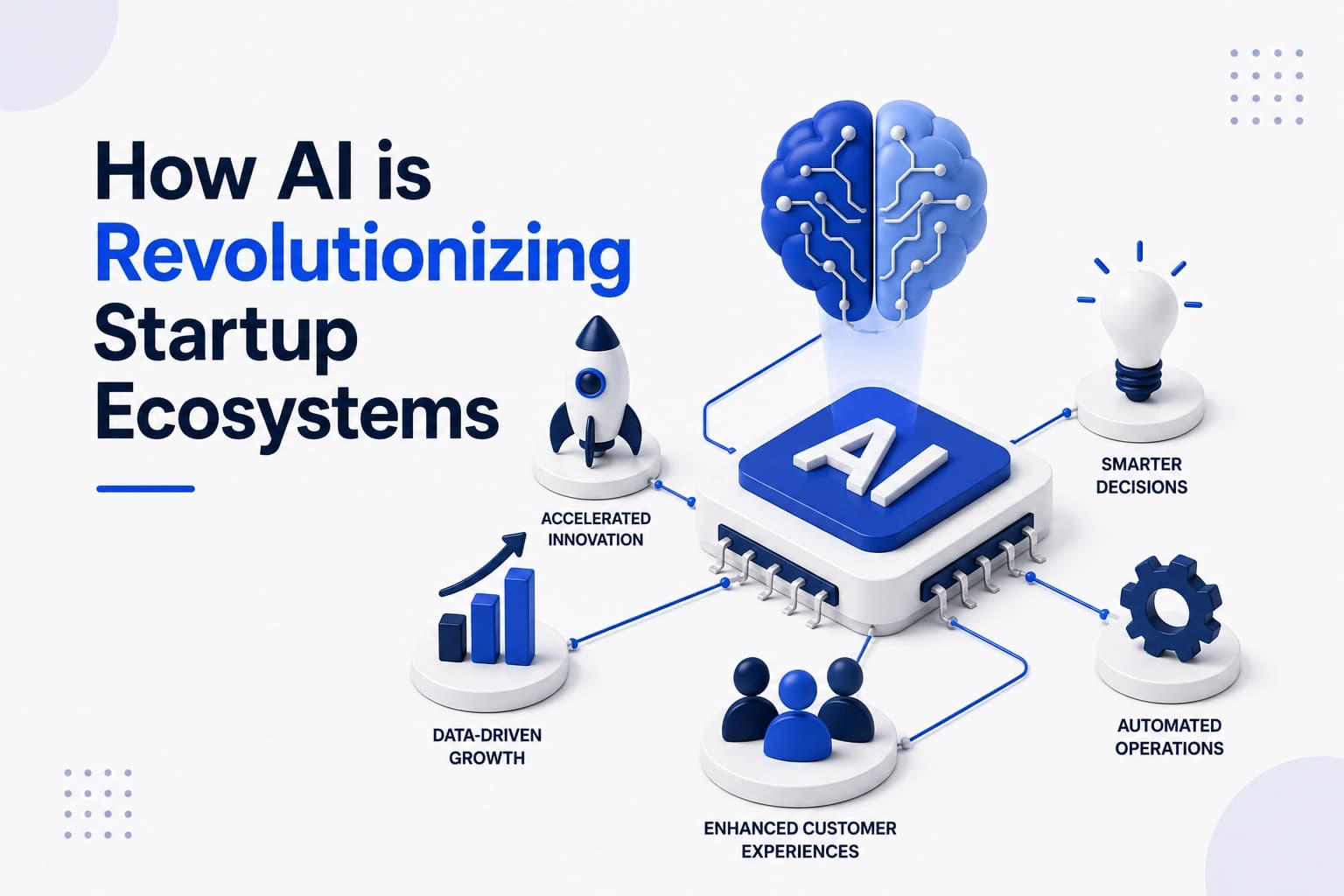
Key takeaway: AI is no longer a novelty; it is fundamental infrastructure. Startups that leverage agentic AI workflows to automate operations, scale personalized Go-To-Market efforts, and augment engineering capabilities are outperforming traditional teams. However, successful implementation requires strict data privacy, human-in-the-loop safeguards, and proprietary data moats.
Target Audience & Use Case: Ideal for startup founders, CTOs, and operators looking to integrate AI beyond simple wrappers to achieve true operational leverage and product differentiation.
AI is no longer just a shiny feature to add to a pitch deck; it is the fundamental infrastructure of the next generation of startups. Companies leveraging AI properly are operating with leaner teams, moving faster, and delivering hyper-personalized experiences at a fraction of the traditional cost.
As detailed in Andreessen Horowitz's guide on Generative AI, the transition from "generative" AI to "agentic" workflows means that AI isn't just writing text or code anymore—it is actively making decisions, healing broken deployments, and running entire operational pipelines autonomously.
This guide breaks down exactly where early-stage founders should deploy AI to get maximum leverage, while avoiding the trap of building "AI wrappers" with no real moat.
AI Leverage Points
Decrease friction
AI dramatically reduces the friction between an idea and its execution. What used to take a specialized team weeks can now be prototyped in days.
Enhance creativity
AI doesn't replace human ingenuity; it augments it. It acts as an endless brainstorming partner, removing the fear of the blank page.
Automate actions
Move beyond generation. Use autonomous agents to execute repetitive background tasks, monitor system health, and resolve tier-1 issues.
Product and UX transformation
Users are shifting away from navigating complex, multi-page graphical interfaces. They expect conversational, intent-driven UI where they state their goal, and the software handles the execution.
Integrate AI to anticipate user needs. Provide smart defaults, auto-complete complex forms, and summarize large datasets natively within your app.
Focus on proprietary data. The only way to build a moat against big tech is by training or fine-tuning models on data that only your startup possesses.
Internal operational leverage
Automate your customer support triage. Let an AI agent categorize tickets, resolve common queries instantly, and escalate complex issues with full context to a human.
Use AI for QA and code health. Autonomous testing agents can write unit tests, identify deployment issues, and even self-heal broken scripts.
Streamline data entry and CRM hygiene. Sales teams should spend time talking to clients, not updating Salesforce. AI can summarize call transcripts and update fields automatically.
Go-to-market and content
Scale personalized outreach. AI allows you to generate highly specific, account-based marketing (ABM) emails that actually reference a prospect's recent company news.
Accelerate SEO content production. Use AI to draft initial outlines and structures, but always maintain a human editor in the loop to add unique voice and insights.
Generate ad creatives dynamically. Test dozens of ad variations (image, copy, format) without needing a massive design team.
Risk, compliance, and trust
AI introduces hallucinations. If you are building for enterprise, you must implement strict guardrails and Human-In-The-Loop (HITL) systems for critical workflows.
Data privacy is non-negotiable. Ensure you are not training public models on your customers' private data. Use secure enterprise APIs or self-hosted open-source models.
Maintain transparency. If a user is interacting with an AI agent, make it explicitly clear. Deception destroys brand trust.
Talent and team design
The profile of an ideal early hire is changing. You need "AI-empowered generalists" who can leverage tools to do the work of three specialists.
Make AI literacy a core competency for every role. Marketing, sales, and operations should be just as fluent in prompting and automation as your engineers.
Your engineering team should focus on architecture and business logic, delegating boilerplate code generation to AI copilots.
◆ Execution blueprint
Phased timeline to integrate AI into your startup's operations.
| Phase | Goal | Output | Timeline |
|---|---|---|---|
| Audit | Find AI use cases | AI Audit Doc | Week 1 |
| Prototype | Build internal tool | MVP Bot | Week 2 |
| Test | Validate workflow | User Data | Weeks 3-4 |
| Rollout | Deploy to team | Live Agent | Week 5 |
| Scale | Expand AI features | AI Native Ops | Ongoing |
Reference table
| AI Metric | Focus Area |
|---|---|
| Time Saved | Internal Operations |
| Content Output | Marketing & SEO |
| Support Deflections | Customer Success |
| Error Reduction | QA & Engineering |
| Lead Qualification | Sales & Outbound |
Key points
- AI is a fundamental utility, not just a feature.
- Agentic workflows are replacing basic generation.
- Build moats using your proprietary data.
- Shift toward intent-driven UX over complex menus.
- Automate repetitive tasks to keep your team lean.
- Use AI for hyper-personalized outbound sales.
- Maintain Human-In-The-Loop for critical decisions.
- Ensure strict data privacy and compliance.
- Hire generalists who are fluent in AI tools.
- Don't build wrappers; build real workflows.
Action checklist
- Audit 3 manual workflows for AI automation
- Deploy an AI copilot for your dev team
- Integrate an AI support triage bot
- Test AI-generated personalized outbound
- Establish a company AI usage policy
- Audit data pipelines for AI compliance
- Create a shared prompt library
- Transition 1 form to a conversational UI
- Set up AI monitoring for deployment health
- Provide weekly AI tool training to staff
Frequently asked questions
Quick answers to what founders usually ask about AI.
Will AI replace my developers?
No, but developers who use AI will replace developers who don't. AI is exceptionally good at writing boilerplate code, unit tests, and debugging, which frees up your engineering team to focus on complex architecture, security, and unique business logic.
No, but developers who use AI will replace developers who don't. AI is exceptionally good at writing boilerplate code, unit tests, and debugging, which frees up your engineering team to focus on complex architecture, security, and unique business logic.
Is it safe to put customer data into AI?
Never put sensitive customer data into public models like the default ChatGPT. For enterprise use cases, you must use secure, compliant enterprise APIs (like OpenAI Enterprise or Anthropic via AWS/GCP) where data is explicitly not used for model training, or host your own open-source models.
How do we build an AI culture?
It starts from the top. Provide every employee with a budget for AI tools (Copilot, Claude, ChatGPT Plus). Encourage teams to share their best prompts in a public Slack channel, and reward employees who use AI to eliminate manual data entry or repetitive workflows.
What about copyright and AI models?
This is a rapidly evolving legal space. To protect your startup, ensure any generative assets (code, images, marketing copy) used in your core product are heavily reviewed or modified by humans. Avoid building a business model that relies entirely on scraping and regurgitating copyrighted material.
How does AI handle hallucinations?
Hallucinations are inevitable. The solution is architectural. Use Retrieval-Augmented Generation (RAG) to ground the AI in factual data. For mission-critical workflows—like our own project KernHell, an AI-powered autonomous testing agent—you must implement self-healing scripts and strict Human-in-the-Loop (HITL) fallback mechanisms.
Can MYSTARTUPWAVE help implement AI?
Yes. We help startups move beyond basic wrappers to implement deep AI integrations—from autonomous testing agents to custom RAG pipelines that securely leverage your proprietary business data.
Need implementation support?
MYSTARTUPWAVE helps founders and teams ship product, growth, and cloud delivery with clear milestones.