How to Build a High-Converting Landing Page
Conversion-focused structure, messaging, and UX for better lead quality. Stop wasting ad spend on pages that don't convert.
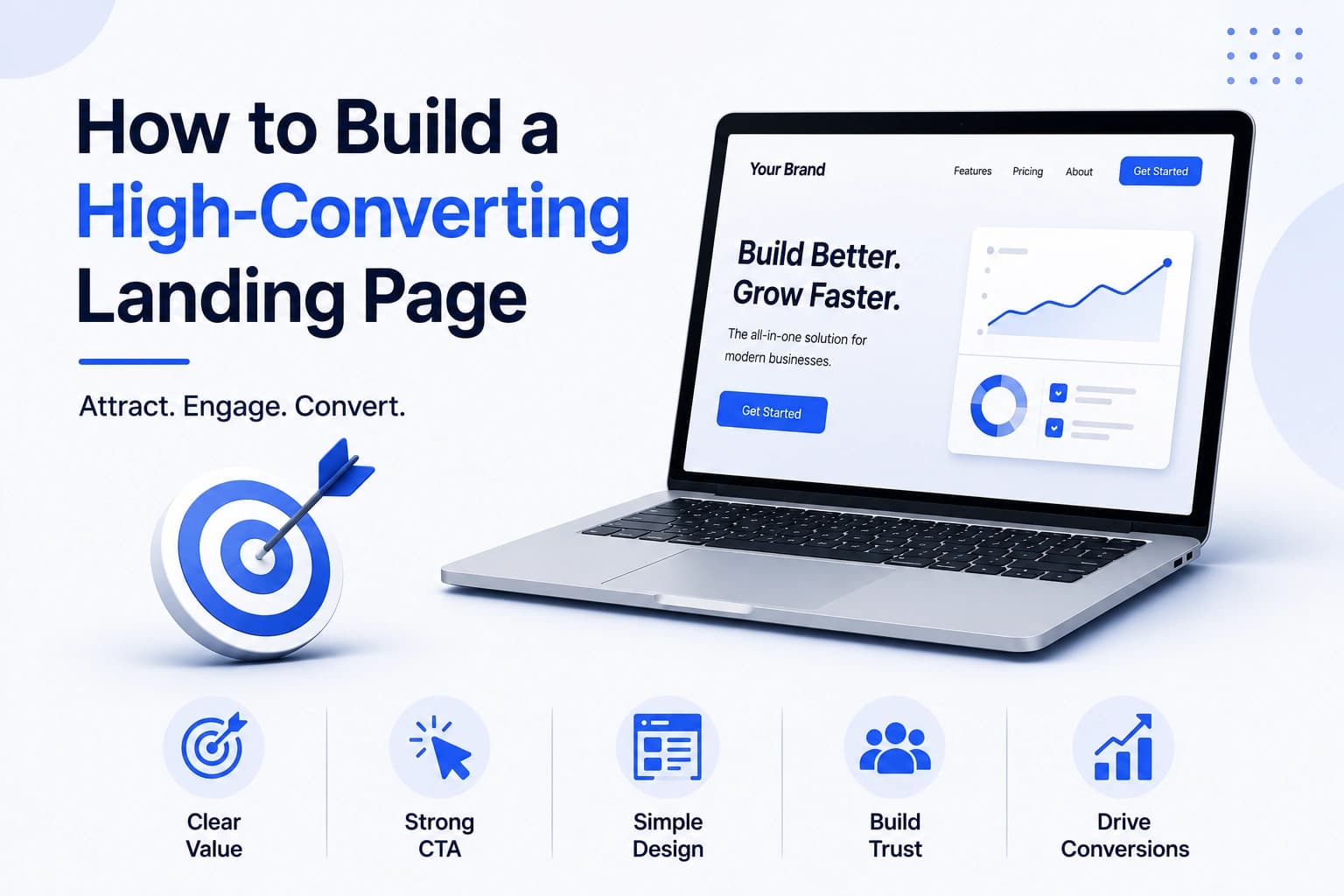
What is a high-converting landing page? A high-converting landing page is a standalone web page designed with a single, focused objective (Call-to-Action) that uses persuasive messaging, social proof, and frictionless UX to maximize the percentage of visitors who become leads or customers.
Key takeaway: A landing page is a psychological journey, not a digital brochure. To drastically improve Conversion Rate Optimization (CRO), strip away external navigation, prioritize clarity over cleverness in your headlines, place your primary CTA above the fold, and guarantee sub-2-second load times.
Target Audience & Use Case: Written for startup founders, growth marketers, and performance marketing teams who are running paid ad campaigns (Google Ads, LinkedIn Ads) and need to improve their ROAS by converting more traffic into qualified leads.
Driving traffic to your startup is expensive and time-consuming. But if that traffic lands on a confusing, poorly structured webpage, all that effort is entirely wasted. A landing page has exactly one job: conversion.
Most founders treat landing pages like digital brochures, cramming them with technical features and company history. In reality, a high-converting page is a psychological journey. It must instantly communicate value, build unbreakable trust, and remove every ounce of friction from the signup process. According to research from Unbounce's Conversion Benchmark Report, the median conversion rate across all industries hovers around 4.3%, but top-performing pages routinely see 10% or higher simply by adhering to strict CRO fundamentals.
This guide breaks down the anatomy of a perfect landing page, from writing an irresistible above-the-fold headline to designing a user experience (UX) that makes clicking your Call-To-Action (CTA) the most logical next step.
CRO Principles
Clarity over cleverness
If a user cannot figure out exactly what you do within 3 seconds, they will bounce. Cut the jargon and speak plainly.
Above the fold
The hero section is your most valuable real estate. Your headline, subheadline, and primary CTA must be visible without scrolling.
Speed is conversion
A 1-second delay in page load time can reduce conversions by 7%. Optimize images and code for blistering fast delivery.
How to optimize messaging and structure?
Your H1 headline must state the ultimate benefit. Focus on the outcome the user desires, not the technical mechanism. For example, 'Close deals 40% faster' beats 'An AI-powered CRM plugin.'
Structure the page logically: Hook (Hero) → Problem Agitation → Solution → Social Proof → Final CTA.
Sell benefits first, features second. Users care about saving time, not the fact that you use AES-256 encryption. Highlight the time saved first, then back it up with the encryption spec.
Why is proof and trust critical for conversions?
Claims without evidence are just noise. You must include social proof immediately below the hero section to validate your bold claims.
Use real faces, exact numbers, and authentic testimonials. "Saved us 40 hours a month" beats "Great product!"
Include trust badges (e.g., "Trusted by 10,000+ teams" or logos of well-known clients). B2B buyers look for safety in numbers before committing to a demo.
How do you remove forms and friction?
Every additional form field reduces your conversion rate. Ask only for what is strictly necessary (often just a work email).
Offer social logins (Google, GitHub) to reduce signup friction to a single click.
Address objections directly next to the button (e.g., "No credit card required," "Cancel anytime"). This microcopy can lift conversions by several percentage points.
What design and UX elements drive action?
Use visual hierarchy to guide the eye toward the CTA. Make your button a high-contrast color that stands out from the rest of the page.
Embrace whitespace. Cluttered designs cause cognitive overload and decision paralysis.
Ensure the mobile experience is flawless. Over 50% of your ad traffic will likely come from mobile devices, so forms and buttons must be large and easily tappable.
How to approach testing and analytics?
Never guess; always test. Run A/B tests on your headlines and CTA button copy to see what actually drives action.
Use heatmaps and session recordings (like Hotjar or Microsoft Clarity) to see exactly where users drop off and where they rage-click.
Track conversion rate per channel. Traffic from a LinkedIn ad will convert differently than organic search traffic, and your messaging should adapt accordingly.
◆ Execution blueprint
Phased timeline to build and launch a high-converting page.
| Phase | Goal | Output | Timeline |
|---|---|---|---|
| Research | Define customer pain | Messaging Doc | Day 1 |
| Copywriting | Draft the narrative | Page Copy | Day 2-3 |
| Wireframe | Plan visual layout | Figma draft | Day 4 |
| Build | Develop and optimize | Live Page | Day 5-7 |
| Test | Drive traffic & analyze | A/B Test results | Ongoing |
Reference table
| Metric | Target Standard |
|---|---|
| Conversion Rate | 5% - 10% (B2B SaaS) |
| Bounce Rate | Under 60% |
| Time on Page | Above 1:30 minutes |
| Page Load Speed | Under 2.5 seconds |
| Scroll Depth | 50%+ reaching the bottom CTA |
Key points
- Clarity always beats cleverness in headlines.
- Your hero section determines if they stay or bounce.
- Benefits sell, features justify the purchase.
- Use high-quality product images or videos, not stock photos.
- Social proof is non-negotiable for building trust.
- Remove all external navigation links; keep them focused.
- The CTA button must be the most visually striking element.
- Optimize for mobile-first; text must be highly readable.
- Reduce form fields to the bare minimum.
- Never stop A/B testing your messaging.
Action checklist
- Write a clear, benefit-driven H1 headline
- Ensure the primary CTA is above the fold
- Add a subheadline clarifying the "How"
- Embed at least 3 customer testimonials
- Include a 'Trusted By' logo banner
- Remove header/footer navigation links
- Optimize all images to WebP format
- Install a session recording tool (e.g., Hotjar)
- Verify mobile responsiveness on real devices
- Set up a Google Optimize A/B test for the headline
Frequently asked questions
Quick answers to what founders usually ask about landing pages.
How long should my landing page be?
It depends entirely on the complexity and cost of your product. A free newsletter signup can be extremely short (just a hero section). A $500/month enterprise SaaS tool requires a long-form page to handle objections, build massive trust, and thoroughly explain the value proposition.
It depends entirely on the complexity and cost of your product. A free newsletter signup can be extremely short (just a hero section). A $500/month enterprise SaaS tool requires a long-form page to handle objections, build massive trust, and thoroughly explain the value proposition.
Should I include pricing on the landing page?
Yes, for B2C and low-touch B2B SaaS. Hiding pricing creates friction and bounce rates. However, for enterprise-level B2B products requiring a custom sales motion, a 'Book a Demo' or 'Get a Quote' approach is standard.
What is a good conversion rate?
Across industries, a 2% to 5% conversion rate is average. Anything above 10% is excellent. However, B2B lead generation pages typically convert lower (1-3%) than free B2C trial signups (8-15%). Focus on improving your baseline rather than chasing industry averages.
How do I choose the right CTA color?
The 'psychology of color' is mostly a myth in CRO. The only rule that matters is high contrast. If your page is mostly blue and white, a bright orange or red button will convert best because it draws the eye immediately. It must stand out from the background.
Can MYSTARTUPWAVE design my landing page?
Yes. We specialize in designing and developing high-converting, blazing-fast landing pages optimized for early-stage startups to maximize their ad spend and organic traffic.
Need implementation support?
MYSTARTUPWAVE helps founders and teams ship product, growth, and cloud delivery with clear milestones.