From Idea to MVP: A Complete Startup Launch Guide
Follow a step-by-step roadmap to move from idea to MVP with customer validation, lean planning, focused build decisions, and a launch that saves time.
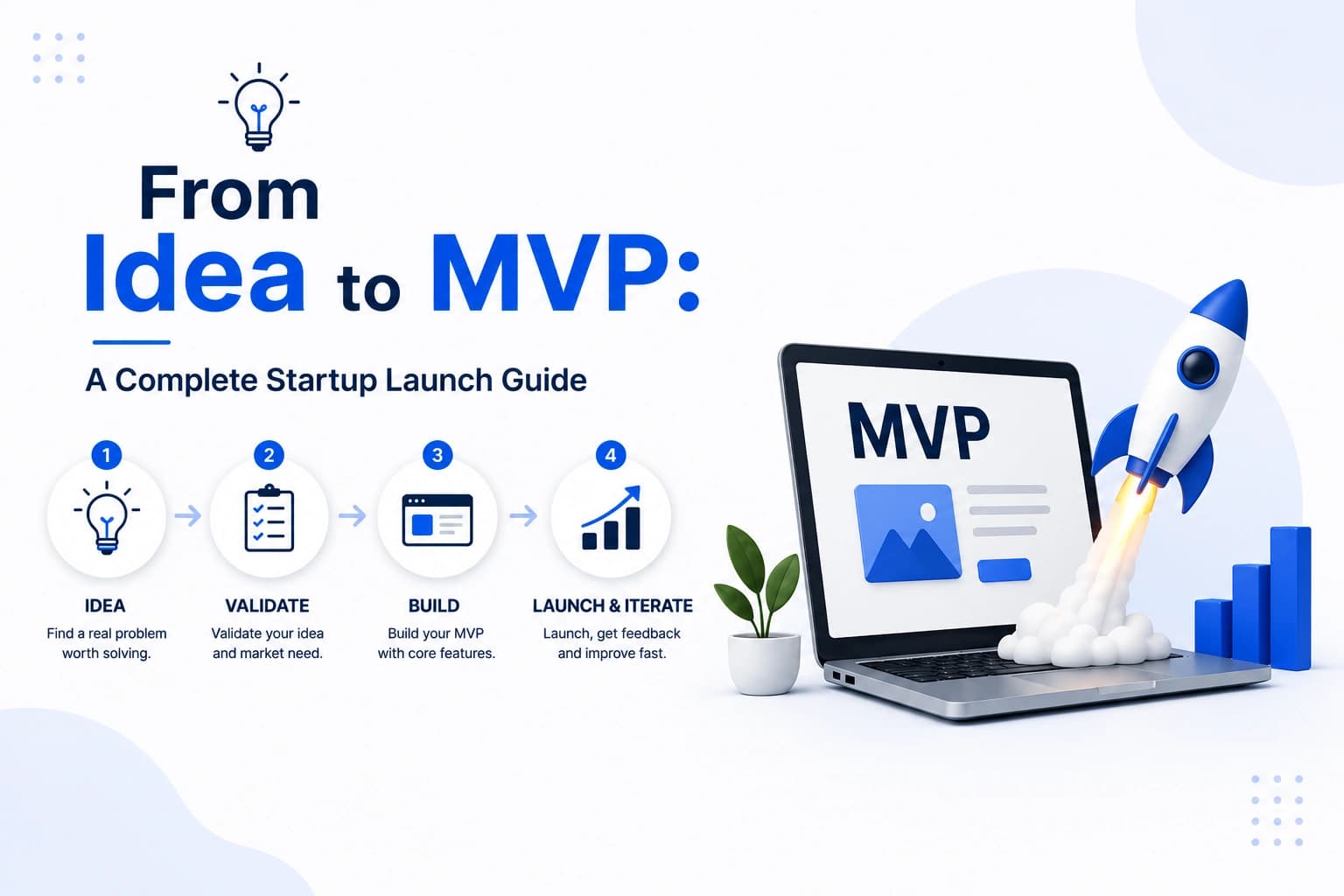
Key takeaway: An MVP is not a final product; it is a tool for learning. Launching successfully requires ruthless scoping, hard deadlines, and qualitative customer feedback rather than endless feature development.
Target Audience & Use Case: This launch guide is designed for early-stage startup founders and product teams looking for a structured, lean methodology to ship their first minimum viable product in 4 to 8 weeks.
Launching your MVP is not about building the perfect product; it is about building the fastest vehicle to validate your core hypothesis. According to CB Insights, 35% of startups fail because there is no market need for what they built. Too many founders spend months in stealth mode only to launch to crickets because they built in a vacuum.
A true MVP (Minimum Viable Product) is exactly that: minimum. It should solve one specific problem for one specific type of user, and it should do it well enough that they are willing to overlook the missing features and unpolished UI.
This guide breaks down the five phases of launching a startup. From discovery to iteration, follow these steps to ensure you are not wasting time on things that do not move the needle. Use this roadmap to keep your team focused, your scope narrow, and your launch timeline aggressive.
Launch Principles
MVP is a process
It is not a final product. It is a tool for learning. If you are not slightly embarrassed by your first release, you launched too late. Get it in front of real users early.
Speed over perfection
Momentum is the lifeblood of a startup. Shipping quickly allows you to gather real-world data instead of debating opinions in a meeting room for weeks on end.
Scope ruthlessly
Every feature you add delays your launch and complicates the user experience. Cut anything that does not directly prove your core value proposition to your initial ICP.
Phase 1: Discovery and validation
Talk to users before you write a single line of code. Validate the pain point and their willingness to pay for a solution. If the problem isn't painful, they won't switch.
Define your ICP (Ideal Customer Profile) and focus exclusively on their most acute problem. Do not try to build a product for everyone on day one.
Document your assumptions and design cheap experiments to test them before committing to a long build cycle.
Phase 2: Specification and design
Create a one-page PRD (Product Requirements Document) to align the team. Keep it simple: what are we building, who is it for, and what is out of scope.
Design the core user flow. Keep the UI simple and focus entirely on the "happy path" first. Edge cases can be handled manually in the beginning.
Do not over-engineer the architecture. Build for your first 1,000 users, not your first million. Scalability problems are a luxury for later.
Phase 3: Build with quality bars
Focus on the core loop. Authentication, complex billing, and deep settings can often be bypassed or done manually behind the scenes at first.
Set a hard deadline for the build phase. Two to four weeks is ideal for software MVPs. Timeboxing forces you to cut unnecessary features.
Test the critical path rigorously. Visual bugs in secondary features are acceptable, but the core value proposition must work flawlessly.
Phase 4: Launch and distribution
Do a soft launch with a select group of beta testers or design partners to iron out early onboarding issues and bugs.
Choose one primary distribution channel (e.g., outbound sales, SEO, community) and hit it hard. Do not spread your marketing efforts too thin early on.
Set up basic analytics to track activation and retention. You need to know exactly what users do once they sign up.
Phase 5: Learn and iterate
Talk to your first users immediately. Qualitative feedback over a call is just as important as the quantitative data in your dashboard.
Look for patterns in feature requests, but do not blindly build what users ask for. Find the root problem they are trying to solve.
Decide whether to pivot, persevere, or double down based on the actual usage data you have collected.
◆ Execution Blueprint
Phased plan you can run with your team—goals, outputs, and timing in one view.
| Phase | Goal | Output | Timeline |
|---|---|---|---|
| Discovery | Validate pain | User interviews | Week 1 |
| Spec | Define scope | PRD & Wireframes | Week 2 |
| Build | Ship core loop | Usable MVP | Weeks 3-5 |
| Launch | Get first users | Marketing push | Week 6 |
| Iterate | Improve retention | Product updates | Ongoing |
Reference table
| Risk | Early signal | Mitigation |
|---|---|---|
| Building wrong thing | No signups | Validate before coding |
| Feature creep | Missed deadlines | Ruthless prioritization |
| Bad UX | High bounce rate | User testing sessions |
| No distribution | Zero traffic | Plan marketing early |
| Technical debt | Constant crashes | Refactor core paths |
Key points
- The MVP is a process for learning, not a final destination.
- Speed to market beats a perfect feature set.
- Scope down to one core workflow and master it.
- Talk to real users before writing any code.
- Keep your architecture simple for the first 1,000 users.
- Timebox the build phase to force prioritization.
- Test the critical path rigorously; ignore minor visual bugs.
- Choose one acquisition channel and focus efforts there.
- Set up analytics to track what users actually do.
- Iterate based on root problems, not just feature requests.
Action checklist
- 10+ customer discovery interviews completed
- One-page PRD written and approved
- MVP scope trimmed to only the critical path
- Wireframes designed for the happy path
- Build timeline hard-capped at 4 weeks
- Basic analytics (Mixpanel/GA) installed
- Soft launch beta group secured (10-20 users)
- Primary go-to-market channel defined
- User feedback loop (Slack/Email) established
- Post-launch iteration meeting scheduled
Frequently asked questions
Quick answers to what founders usually ask about launching an MVP.
How much does it cost to build an MVP?
MVP costs vary wildly from $500 (no-code tools) to $50,000+ (custom engineering). The key is spending the absolute minimum required to prove your riskiest assumption. Often, a high-fidelity prototype or a landing page is enough to start.
MVP costs vary wildly from $500 (no-code tools) to $50,000+ (custom engineering). The key is spending the absolute minimum required to prove your riskiest assumption. Often, a high-fidelity prototype or a landing page is enough to start.
Should I learn to code or hire a developer?
If you have the time and inclination, learning no-code tools (Bubble, Webflow) is the fastest way to validate. If you have capital but no time, hire an agency like MyStartupWave to build a scalable foundation quickly while you focus on sales.
How long should it take to launch my MVP?
Aim for 4 to 8 weeks. If it takes longer than 3 months, you are likely overbuilding and adding features that customers haven't actually asked for yet.
Do I need to incorporate a company before launching?
Not necessarily for validation. You can test demand and collect emails without a legal entity. However, once you start accepting money or entering into contracts with partners/co-founders, incorporation (like a Delaware C-Corp) becomes necessary.
What if someone steals my idea?
Ideas are cheap; execution is everything. The fear of someone stealing your idea is far less dangerous than the reality of building something nobody wants because you kept it a secret. Share it openly to get feedback.
Need implementation support?
MYSTARTUPWAVE helps founders and teams ship product, growth, and cloud delivery with clear milestones.