Personal Branding for Founders: Why It Matters More Than Ever
Understand why personal branding matters for founders and visibility. Build trust, attract talent, and drive early traction by scaling your reputation.
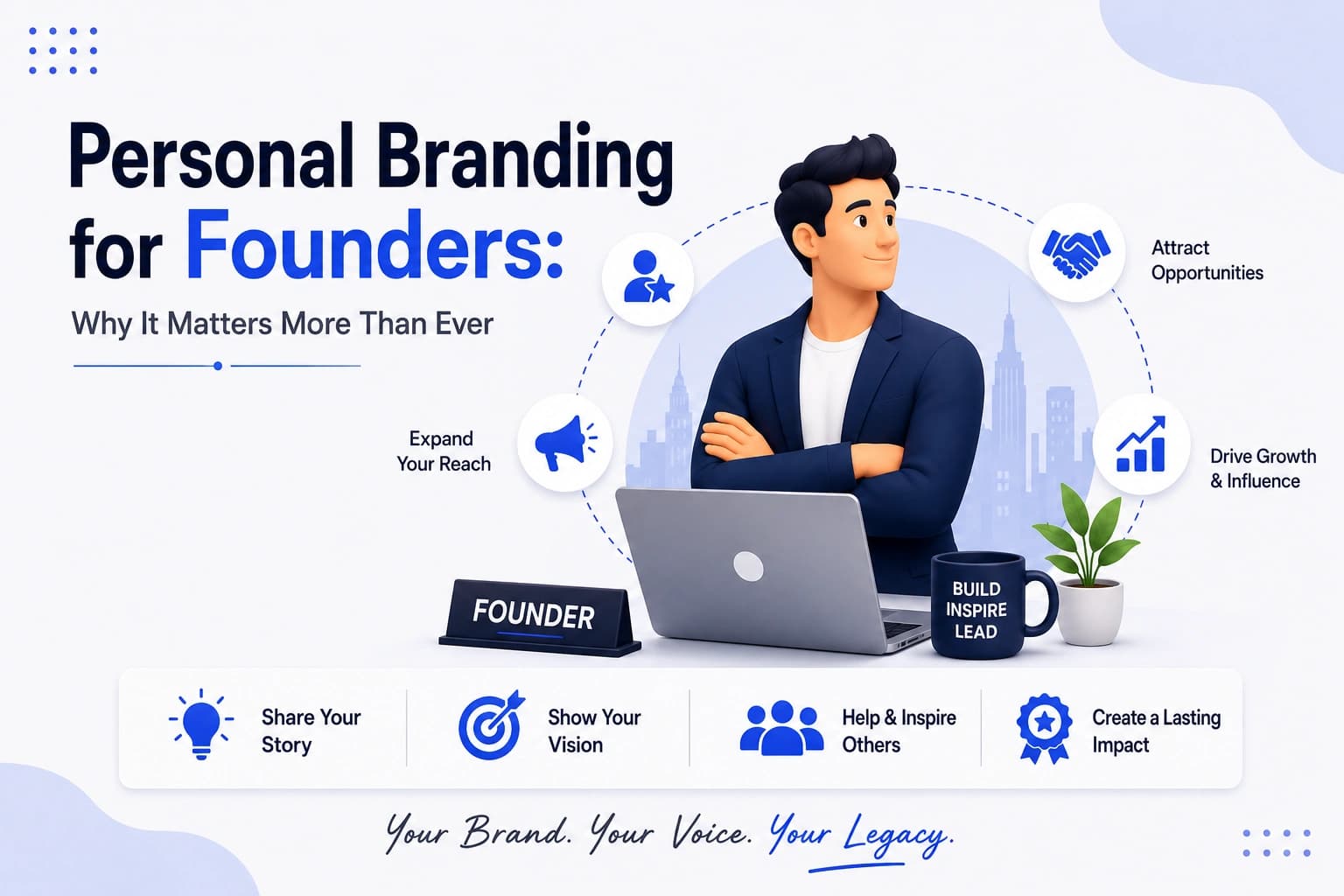
What is personal branding for founders? Personal branding for founders is the strategic process of scaling your professional reputation online. It involves publicly sharing your insights, failures, and company-building journey to build trust and authority in your niche.
Key takeaway: People invest in and buy from people they trust, not faceless logos. By consistently publishing authentic, high-signal content, founders create a "halo effect" that lowers customer acquisition costs (CAC), attracts top engineering talent, and builds a portable audience that outlasts any single product iteration.
Target Audience & Use Case: Tailored for startup founders, co-founders, and C-suite executives who want to leverage their unique industry expertise to drive inbound leads, close funding rounds faster, and build a lasting industry presence.
Personal branding for founders is no longer an ego-driven vanity project; it is a critical business asset. In the early stages, investors fund the founder before the product, and early adopters buy the founder's vision before the software matures.
A strong personal brand creates a massive halo effect. It lowers customer acquisition costs, attracts top-tier talent, and provides a safety net during product pivots. According to Harvard Business Review, founders who actively cultivate a public narrative are significantly more likely to secure favorable terms during early-stage fundraising because investors perceive them as de-risked operators with established industry authority.
People connect with people, not faceless corporate logos. When you build in public and share your authentic journey, you build an audience that roots for your success.
This guide breaks down how to construct a founder brand that aligns with your company goals without feeling like you are constantly bragging.
Brand Pillars
Authenticity
Your online persona must match your real-life personality. Inconsistencies destroy trust faster than silence.
Value trajectory
Constantly share insights that help your target audience. Give away your secrets for free.
Vulnerability
Sharing failures and lessons learned builds deeper connections than only posting highlight reels.
How do you clarify your founder narrative?
What is your origin story? Why are you uniquely positioned to solve this specific problem? If you are building a healthcare SaaS, your years spent struggling as a clinic manager is the most important part of your narrative.
Identify your "villain"—the broken industry standard you are fighting against. Having a clear enemy (like 'wasted time' or 'bloated software') gives your audience something to rally behind.
Develop a 3-sentence elevator pitch that works for investors, hires, and customers alike. It should clearly define who you help and why you care.
What channels should founders prioritize?
Pick one primary text platform (LinkedIn or X) and master it before expanding. For B2B founders, LinkedIn currently offers the highest organic reach and the most direct path to decision-makers.
Limit your content to 3 core topics (e.g., your industry insights, tactical startup lessons, and personal growth). If you talk about everything, you become known for nothing.
Consistency beats virality. Post high-signal content on a regular schedule. A viral meme gets likes, but a deeply technical teardown gets booked demos.
How do networking and reciprocity fuel growth?
Personal branding is a two-way street. Actively engage with other founders and thought leaders in your niche to tap into their existing audiences.
Provide thoughtful, paragraph-long comments on other people's posts. Generic 'great post!' replies do nothing. Add a supplementary insight that proves your expertise.
Host or join podcasts. Being a guest on a niche podcast allows you to borrow an audience for 45 minutes and establish deep, parasocial trust.
How should founders handle public criticism?
As your visibility grows, so will criticism. Develop a thick skin and ignore obvious trolls who only want engagement.
If you make a genuine mistake—like a bad product release or a poorly worded statement—address it publicly, own the error immediately, and explain the exact steps you are taking to fix it.
Never punch down. Keep your public interactions professional, constructive, and focused on the work, not personal attacks.
How does a founder brand align with the company brand?
Your personal brand should serve as a powerful acquisition funnel for your company, but it should not be identical to the corporate brand. You can have opinions; a corporate logo cannot.
Ensure your personal values align seamlessly with the company's mission statement to avoid cognitive dissonance for your customers.
Over time, as the company scales past Series A or B, intentionally transition the audience's attention from you as an individual to the company as a durable institution.
◆ Execution blueprint
Phased timeline to establish your personal brand.
| Phase | Goal | Output | Timeline |
|---|---|---|---|
| Audit | Audit current profiles | Profile refresh | Week 1 |
| Narrative | Draft origin story | Narrative doc | Week 2 |
| Pillars | Define content topics | Content matrix | Week 3 |
| Batch | Write first 10 posts | Scheduled queue | Week 4 |
| Engage | Daily networking | Growing network | Ongoing |
Reference table
| Metric | Focus Area |
|---|---|
| Profile Views | Top-of-funnel reach |
| Follower Growth | Audience expansion |
| Inbound Connections | Networking ROI |
| Post Impressions | Content resonance |
| Newsletter Subs | Owned audience |
Key points
- Your brand is what people say about you when you leave the room.
- Authenticity is the ultimate growth hack.
- Share your failures as openly as your successes.
- Pick one primary platform and dominate it.
- Always provide actionable value to your audience.
- Engage with peers to build a supportive network.
- Handle criticism with grace and professionalism.
- Your personal brand is a funnel for your startup.
- Consistency builds trust over time.
- Transition focus to the company as you scale.
Action checklist
- Rewrite your LinkedIn and X bios
- Get professional headshots
- Write down your origin story
- Define your 3 content pillars
- Draft your first 5 high-value posts
- Comment on 5 peers' posts daily
- Reach out to 3 podcast hosts
- Set up an email newsletter
- Add a link to your startup in your bios
- Review audience analytics monthly
Frequently asked questions
Quick answers to what founders usually ask about personal branding.
Is personal branding just bragging?
No, it is about sharing value and building trust. When done right, it is educational and inspiring, not self-promotional. You are building in public to help others learn from your journey, not just to show off your wins.
No, it is about sharing value and building trust. When done right, it is educational and inspiring, not self-promotional. You are building in public to help others learn from your journey, not just to show off your wins.
Can introverts build a strong brand?
Absolutely. Introverts often excel at deep, thoughtful writing. You don't need to do energetic video rants or dance on TikTok; a well-written, highly insightful weekly newsletter or LinkedIn text post is incredibly effective for B2B founders.
Do I need to post every day?
No. Consistency beats high frequency. Posting 2-3 high-quality, insightful pieces a week is far better than publishing daily low-effort posts that train your audience (and the algorithm) to ignore you.
What if I pivot my startup?
That is exactly why a personal brand is so valuable. It is tied to YOU, not the specific product. If you pivot, your audience pivots with you because they bought into your problem-solving approach, work ethic, and vision, not just the software.
Are PR agencies worth the cost early on?
Usually, no. In the early days, journalists, investors, and customers want to hear from the founder directly. Spend that PR budget on product and growth, and pitch your own authentic story to niche podcasts and newsletters.
Can MYSTARTUPWAVE help design a founder brand?
Yes. We help founders define their core narrative, set up their content engines, and seamlessly integrate their personal brand with their startup's overall go-to-market strategy.
Need implementation support?
MYSTARTUPWAVE helps founders and teams ship product, growth, and cloud delivery with clear milestones.