Social Media Growth Hacks for Startup Founders
Build visibility and trust with high-signal founder-led content systems.
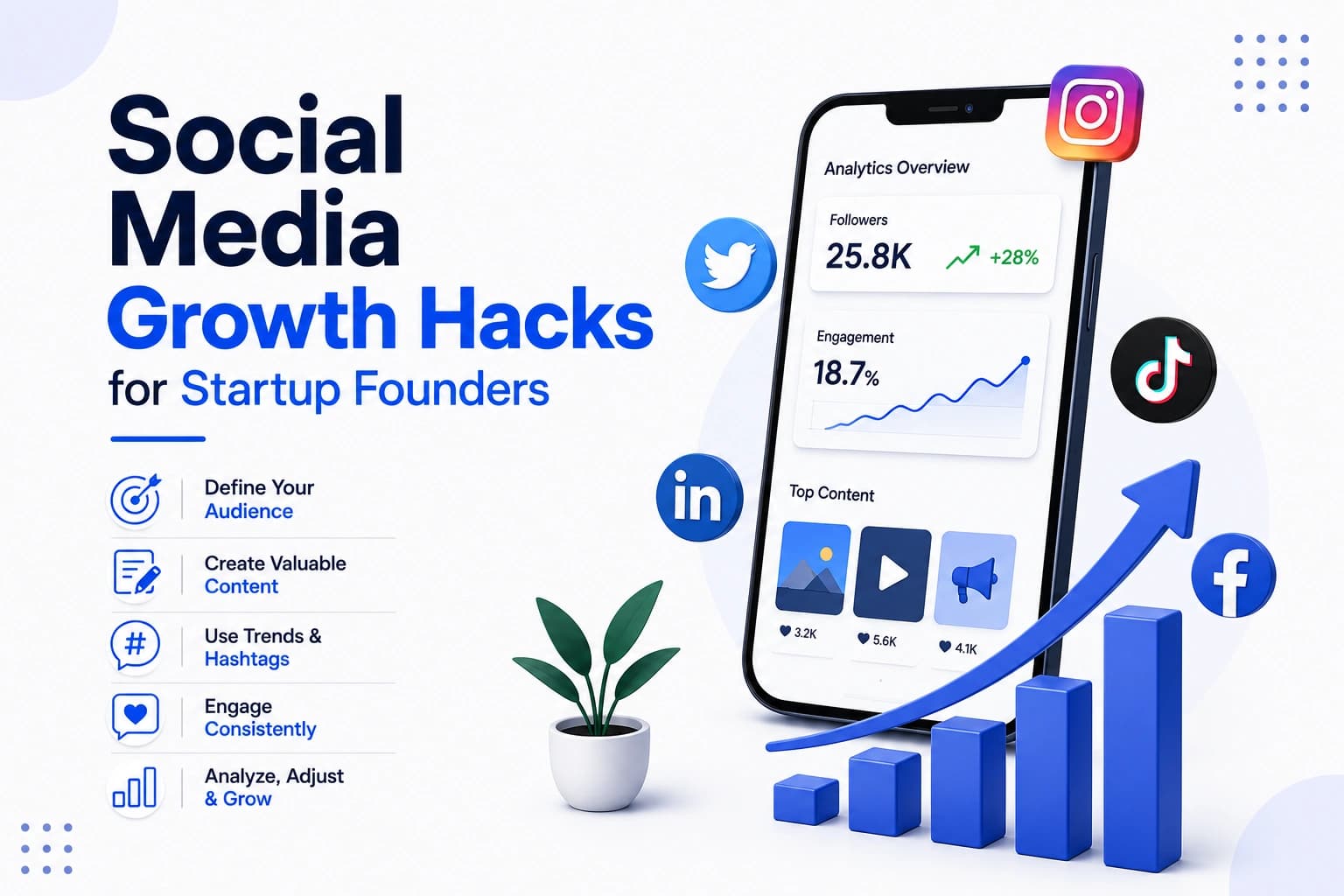
What is founder-led social media growth? Founder-led social media growth is the strategic use of a founder's personal brand on platforms like LinkedIn and X to authentically share their journey, build authority, and acquire early users at a zero-dollar customer acquisition cost (CAC).
Key takeaway: To scale your social media presence, you must prioritize "high-signal" content over generic volume. Document your actual business challenges rather than trying to invent thought leadership. Consistent, value-driven posting from a founder's personal account dramatically outperforms corporate brand pages.
Target Audience & Use Case: Ideal for early-stage startup founders, CEOs, and executive leaders looking to establish a personal brand, attract venture capital, and build an organic audience of early adopters.
Social media is not just a broadcast channel. For founders, it is a high-leverage tool to attract early users, investors, and talent. However, most startup accounts fail because they sound like corporate megaphones instead of real people. In fact, according to a recent LinkedIn B2B Marketing report, personal profiles generate up to 10x more reach and engagement than company pages.
Founder-led growth is the most powerful strategy available today. People connect with people, not logos. Sharing the journey, the failures, and the insights builds a moat that competitors cannot clone. This human-first approach lowers Customer Acquisition Costs (CAC) to near zero while simultaneously establishing industry authority.
This guide covers how to establish a strong presence, the content pillars that actually convert, and how to measure success without burning out.
Growth Principles
Founder-led
People connect with the founder's story more than the product features. Authenticity wins over polished marketing.
High-signal over volume
It's better to post one deeply insightful thread than five generic updates. Quality and relevance attract your true ICP.
Build in public
Sharing your roadmap, wins, and failures builds a loyal community early on. It is a fail-proof approach to gaining traction.
How to choose platforms and positioning?
Focus on where your ICP hangs out. For B2B founders, dominating LinkedIn and X (Twitter) is mandatory for visibility. 80% of B2B social leads come directly from LinkedIn.
Establish a clear, 1-sentence bio that states your value proposition. Make sure visitors know exactly what you are building within three seconds of landing on your profile.
Use high-quality headshots and branded banner images to look professional and trustworthy.
What are effective content pillars and calendars?
Create 3-4 content pillars (e.g., industry insights, company building, personal stories) to keep your messaging focused and varied.
Batch create content to maintain consistency without burnout. Write once a week, post daily.
Use tools to schedule posts but stay active in the comments for community engagement. The algorithm heavily rewards immediate interaction.
Which content formats actually convert?
Text-only posts and value-dense carousels perform exceptionally well on LinkedIn. Carousels routinely see 2x higher engagement rates than single image posts.
Short-form video (TikTok, Reels, Shorts) is unmatched for top-of-funnel consumer reach, with average view durations continually increasing year-over-year.
Always include a clear Call-to-Action (CTA) in your high-performing posts to drive traffic to your startup's landing page or newsletter.
How to build community and partnerships?
Don't just post and ghost. Reply to every meaningful comment on your posts to signal to the algorithm that your content is generating a discussion.
Engage with larger accounts in your niche to siphon their audience naturally through insightful, value-add replies.
Host live audio spaces or webinars to build deeper, real-time connections with your followers and establish definitive authority.
How to measure and iterate on your strategy?
Track profile views, engagement rate, and inbound DMs as leading indicators of success, rather than purely obsessing over follower counts.
UTM tags are crucial for tracking social traffic conversions on your landing pages via Google Analytics.
Double down on the formats and topics that resonate best with your core audience. If carousels drive the most leads, shift 80% of your production effort there.
◆ Execution blueprint
Phased timeline to build a founder-led social engine.
| Phase | Goal | Output | Timeline |
|---|---|---|---|
| Audit | Profile optimization | Bio & Links | Week 1 |
| Strategy | Content pillars | Content calendar | Week 2 |
| Create | Batch write posts | Scheduled queue | Week 3 |
| Engage | Daily community interaction | Reply strategy | Week 4 |
| Iterate | Review analytics | Strategy tweak | Ongoing |
Reference table
| Metric | Definition |
|---|---|
| Engagement Rate | Interactions per impression |
| Profile Views | Top-of-funnel reach |
| Inbound DMs | High-intent leads |
| CTR | Click-through to website |
| Follower Growth | Audience expansion |
Key points
- Founder-led content beats corporate brand accounts.
- Build in public on X and LinkedIn to establish deep trust.
- Focus on high-signal, actionable insights over generic fluff.
- Consistency is significantly more important than virality.
- Batch content creation to avoid daily context switching.
- Engage with your niche's community daily.
- Use carousels and text frameworks for B2B reach.
- Short-form video dominates B2C reach.
- Track inbound DMs as a primary qualitative KPI.
- Always include a clear CTA on viral posts.
Action checklist
- Optimize LinkedIn and X profiles
- Define 3 core content pillars
- Draft a 30-day content calendar
- Batch-write the first 10 posts
- Schedule posts using a buffer tool
- Spend 15 mins/day engaging with peers
- Set up UTMs for profile links
- Reach out to 5 peers for cross-promo
- Review analytics after 14 days
- Adjust strategy based on hard data
Frequently asked questions
Quick answers to what founders usually ask about social media.
How often should I post?
Consistency is more important than frequency. Aim for 3-5 times a week on platforms like LinkedIn or X, but ensure each post provides real value rather than posting just for the sake of the algorithm.
Consistency is more important than frequency. Aim for 3-5 times a week on platforms like LinkedIn or X, but ensure each post provides real value rather than posting just for the sake of the algorithm.
What if I run out of ideas?
Document, don't create. Share your daily challenges, customer conversations, hiring mistakes, and product milestones. You can also use the 'hub and spoke' method: turn one long-form blog post into 5 distinct short social posts.
Should I automate everything?
Automate scheduling, but never automate engagement. Auto-DMs and bot replies destroy trust instantly. Use tools like Buffer, Typefully, or Hypefury for batch scheduling your posts, but always reply to comments manually to build a real community.
How do I deal with haters?
Ignore outright trolls, but embrace constructive disagreement. A polarizing take that gets respectful pushback is actually great for algorithmic reach and proves you have a distinct, confident point of view in your industry.
When should I hire a social media manager?
Hire one only after you have a proven, repeatable content format that resonates with your audience, and you need someone to scale the operational side (scheduling, video editing, formatting). The founder should still dictate the voice and core ideas.
Can MYSTARTUPWAVE manage my founder brand?
We help founders define their content pillars, set up growth systems, and repurpose their insights into high-leverage assets as part of our holistic go-to-market strategies.
Need implementation support?
MYSTARTUPWAVE helps founders and teams ship product, growth, and cloud delivery with clear milestones.