Top Tech Trends Every Startup Should Watch in 2026
The trends shaping product direction, customer behavior, and market timing. Discover what to build now to stay relevant.
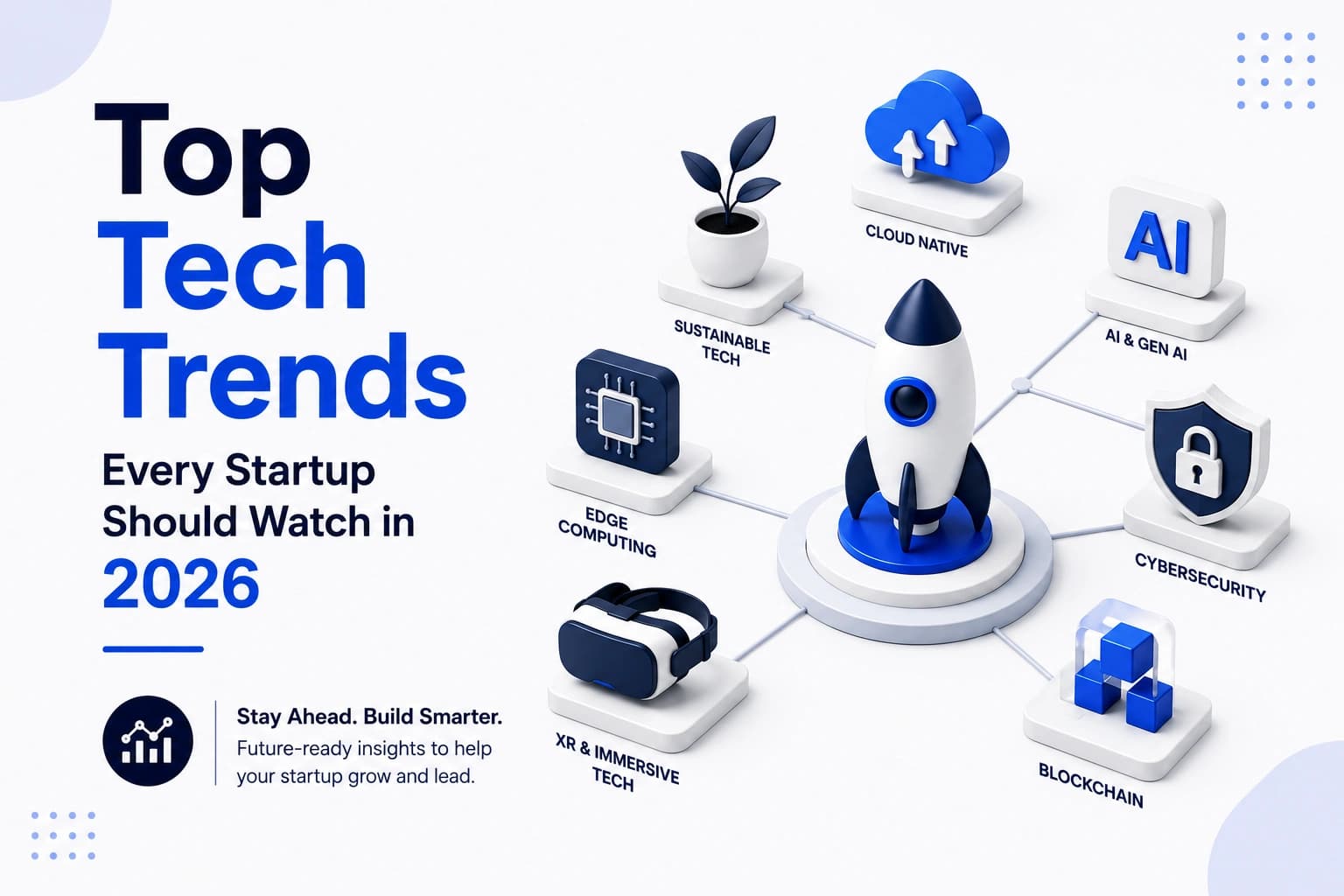
Key takeaway: The tech landscape for startups in 2026 is defined by the shift towards agentic AI workflows, zero-trust security architecture, edge computing for sub-100ms response times, and strict FinOps practices to control spiraling cloud costs. Building modular, API-first stacks is crucial for long-term scalability.
Target Audience & Use Case: Ideal for technical founders, CTOs, and engineering leaders who are making architectural decisions, planning roadmaps, or evaluating new technologies for their products.
Technology is moving faster than ever. In 2026, AI is no longer just a shiny buzzword used in pitch decks; it is an underlying utility expected in every B2B and B2C product. Customers demand faster, smarter, and more secure experiences by default.
As noted by Gartner's strategic tech trends report, startups that fail to adopt these core technological shifts will quickly find themselves outpaced by leaner, tech-forward competitors. But blindly chasing every new framework or trend is equally dangerous—it leads to bloated architecture and crippling technical debt.
This guide breaks down the high-signal tech trends that are fundamentally shifting how software is built, secured, and delivered in 2026.
Innovation Principles
Adaptability over prediction
You cannot predict every shift. Instead, build a modular, API-first tech stack that allows you to swap out services and models as the landscape evolves.
Efficiency is paramount
With capital being more expensive, "growth at all costs" is dead. Architectural decisions must be tied directly to cost optimization and FinOps.
User-centric tech
Technology must serve the user experience, not the developer's ego. A boring stack that delivers a blazing-fast experience beats a hyped stack that crashes.
AI copilots and agentic workflows
We are moving from "generative" AI to "agentic" AI. Users don't just want text output; they want software that can execute multi-step workflows autonomously.
Context is everything. The value of your AI integration depends entirely on how well it connects to the user's proprietary data securely.
Startups must build AI natively into the user journey, not just as a bolted-on chatbot in the corner of the screen.
Security, zero-trust, and supply chain
Software supply chain attacks are increasing. You must audit the open-source libraries and NPM packages your product relies on.
Zero-trust architecture is no longer optional for B2B startups. Never trust, always verify—even inside your own network.
Customers demand SOC2 compliance earlier than ever. Build security and compliance into your CI/CD pipeline from day one.
Edge, real-time, and offline-first
Users expect sub-100ms response times. Processing data at the edge (closer to the user) rather than a central server is becoming the standard.
Offline-first architectures using local databases (like SQLite synced to cloud) ensure users can work seamlessly on planes or trains.
Real-time collaboration (multiplayer mode) is becoming an expected feature in SaaS products.
Sustainable tech and FinOps
Cloud bills are silently killing startups. FinOps (Cloud Financial Management) requires engineering and finance teams to collaborate closely.
Optimize your database queries and avoid over-provisioning servers. Serverless architectures can help scale down costs to zero during low-traffic periods.
Sustainability is becoming a procurement requirement. Enterprise clients are beginning to ask for the carbon footprint of your cloud infrastructure.
Interoperability and APIs
Your software does not exist in a vacuum. If it cannot integrate with Slack, Salesforce, or custom webhooks, enterprises will not buy it.
Design your product API-first. Your own frontend should simply be a consumer of your public-facing API.
Embrace open standards to prevent vendor lock-in, both for your customers and for your own backend services.
◆ Execution blueprint
How to integrate a new tech trend into your roadmap safely.
| Phase | Goal | Output | Timeline |
|---|---|---|---|
| Audit | Assess current stack | Tech debt doc | Week 1 |
| Prioritize | Select highest ROI trend | Engineering roadmap | Week 2 |
| Pilot | Test in a small feature | Working prototype | Weeks 3-4 |
| Integrate | Deploy to all users | Production rollout | Weeks 5-6 |
| Measure | Track performance & cost | Monitoring dashboard | Ongoing |
Reference table
| Trend | Primary Impact Area |
|---|---|
| AI Copilots / Agents | User Productivity & Retention |
| Zero Trust Security | Risk & Enterprise Compliance |
| Offline-first & Edge | Performance & User Experience |
| FinOps | Runway & Profitability Margins |
| API-first architecture | Partnerships & Ecosystem Growth |
Key points
- AI must solve actual workflows, not just generate text.
- Build modular code so you can swap out AI providers easily.
- Security is a feature that enterprise clients buy.
- Never trust internal network requests (Zero-trust).
- Edge computing dramatically reduces TTFB (Time to First Byte).
- Cloud costs scale faster than revenue if left unmonitored.
- Make engineers accountable for the infrastructure cost they deploy.
- APIs should be treated as first-class products.
- Boring technologies (Postgres, React) are often the safest bet.
- Focus on the user experience; tech is just the vehicle.
Action checklist
- Audit your application for AI workflow opportunities
- Run a dependency check on all open-source packages
- Implement MFA and Role-Based Access Control (RBAC)
- Review cloud billing and set up cost alerts
- Cache static assets closer to users using a CDN
- Audit your public API documentation for clarity
- Set up error tracking (e.g., Sentry) for edge cases
- Design a 'graceful degradation' offline state
- Ensure CI/CD pipelines run automated security scans
- Evaluate database queries for latency bottlenecks
Frequently asked questions
Quick answers to what founders usually ask about tech trends.
Which trend is most important for my startup?
It depends entirely on your product. If you are building a B2B SaaS, API interoperability and Zero-Trust security will unblock enterprise sales. If you are building a consumer app, Edge computing for speed and AI for personalization will drive retention. Always prioritize the trend that solves your customer's biggest friction point.
It depends entirely on your product. If you are building a B2B SaaS, API interoperability and Zero-Trust security will unblock enterprise sales. If you are building a consumer app, Edge computing for speed and AI for personalization will drive retention. Always prioritize the trend that solves your customer's biggest friction point.
Should we rebuild our core product with AI?
Not necessarily. If your core product solves a problem efficiently without AI, don't force it. Instead, look for 'AI-adjacent' opportunities, like using LLMs to automate customer onboarding, summarize user data, or generate reports faster.
Is edge computing expensive to implement?
It used to be, but platforms like Vercel and Cloudflare have commoditized edge functions. You only pay for what you use, and the performance gains (lower latency and faster TTFB) often lead to higher conversion rates, making it a net-positive investment.
How do we manage rising cloud infrastructure costs?
Implement FinOps practices early. Right-size your instances, set up strict billing alerts, use serverless databases that scale to zero when idle, and regularly audit your object storage and data transfer egress costs.
Can MYSTARTUPWAVE help modernize our tech stack?
Yes. We specialize in migrating legacy stacks to modern, serverless, and AI-ready architectures, ensuring your product is scalable, secure, and cost-efficient for 2026 and beyond.
Need implementation support?
MYSTARTUPWAVE helps founders and teams ship product, growth, and cloud delivery with clear milestones.