How to Validate Your Startup Idea Before Investing Money
Validation methods to test demand before committing major budget.
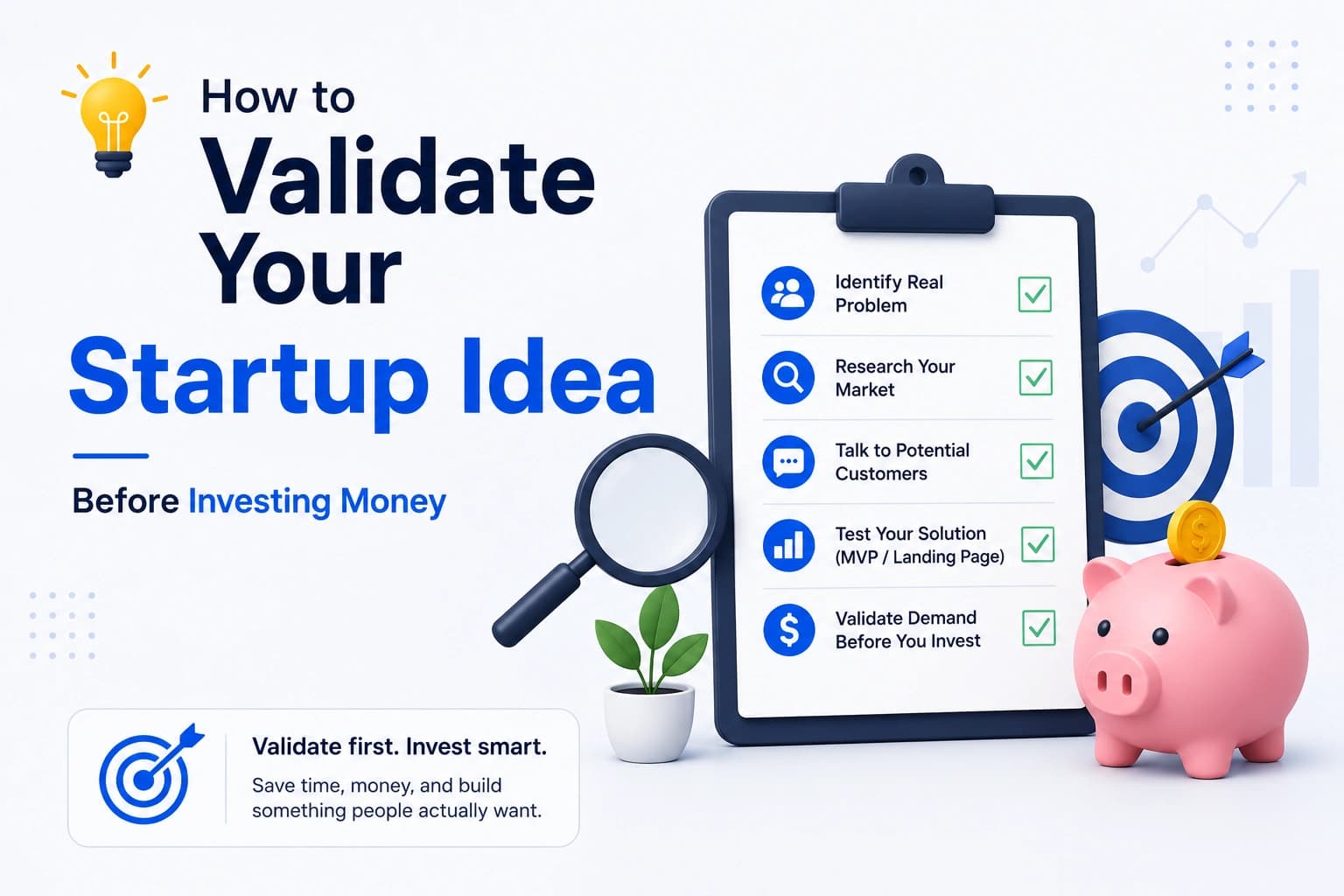
Key takeaway: Validating a startup idea requires testing objective customer behavior—such as pre-sales or clicking a buy button—before spending budget on engineering or marketing.
Target Audience & Use Case: This guide is tailored for aspiring founders, early-stage entrepreneurs, and product managers who need cost-effective methods to test demand in B2B or B2C markets before seeking investment or launching.
According to CB Insights, 35% of startups fail simply because they build something with no market need. Building a product nobody wants is the single biggest cause of startup failure. Founders often mistake their own enthusiasm for market demand. Validation is the process of converting that blind optimism into objective evidence.
The goal of validation is not to get people to say "that's a good idea." It's to get them to commit time, reputation, or money to solve a problem they are actively struggling with.
Before you spend months coding or thousands of dollars on marketing, you need to prove that the pain exists and that your proposed solution is worth paying for.
This guide provides a framework to stress-test your idea using cheap, fast experiments rather than expensive, slow development cycles.
Validation Core
Objective truth
Validation is about finding truth, not confirmation. If you are only looking for reasons why your idea will work, you will miss the red flags that show why it won't.
Action over words
What people say they will do is irrelevant. What they actually do (click, sign up, pay, refer) is the only data that matters in validation.
Iteration
Validation is rarely a simple pass/fail. It usually requires tweaking the audience, the problem, or the solution until you find resonance.
Customer discovery that actually works
Don't pitch your idea. Ask about their past behavior. "How did you solve this last time?" is better than "Would you buy this?"
Talk to strangers. Friends and family will lie to you to protect your feelings. Find your actual target market.
Look for hacks and workarounds. If they are piecing together spreadsheets and Zapier, the pain is real.
Prototype and concierge tests
You don't need code to prototype. Use Figma, Notion, or Webflow to mock up the value proposition visually.
Concierge test. Deliver the value manually behind the scenes. If you are building an AI travel agent, be the travel agent yourself first.
If people aren't willing to endure a clunky, manual experience to solve their problem, it's not a severe enough pain.
Quantitative smoke tests
Set up a landing page explaining the value proposition clearly. Drive targeted traffic via small ad budgets.
Measure conversion. If 100 people visit and 0 give you their email, the idea (or the messaging) needs work.
Add a pricing element. Even if the product isn't ready, see if they will click a "Buy for $49/mo" button before telling them it's out of stock.
When to stop validating and build
Once you have consistent, predictable conversions (emails, pre-sales, letters of intent) from your target audience.
You have a clear understanding of the exact feature set required to deliver the core value—nothing more.
You know exactly where to find your first 100 customers because you already talked to them during validation.
Budgeting validation
Keep it cheap. Spending more than a few hundred dollars on ads and domain names is usually overkill.
Your most expensive asset right now is time. Validation should take days or weeks, not months.
Set a strict "kill criteria." Decide in advance what metric means the idea is dead, so you don't keep pushing a rock uphill.
◆ Execution blueprint
Phased timeline to go from raw idea to validated concept.
| Phase | Goal | Output | Timeline |
|---|---|---|---|
| Hypothesis | Define the problem | Problem brief | Days 1-2 |
| Discovery | Talk to users | Interview notes | Weeks 1-2 |
| Smoke test | Test demand | Landing page | Week 3 |
| Pre-sales | Test WTP | Collected cash | Week 4 |
| Decision | Build or kill | Go/No-Go | Week 5 |
Key points
- Validate the problem before the solution.
- Past behavior is the best predictor of future action.
- Friends and family are invalid data points.
- Manual processes prove severe pain.
- Landing pages are cheaper than code.
- Set a clear kill criteria in advance.
- Pre-sales are the ultimate validation.
- Don't overspend on validation tests.
- Iterate based on feedback, not ego.
- Know your first 100 customers before building.
Action checklist
- Problem brief clearly documented
- 15 customer discovery calls scheduled
- Notes categorized by pain severity
- Figma prototype or mockups created
- Landing page built and live
- $50-100 ad budget allocated
- Conversion metrics tracked
- Pre-sale or waitlist form live
- Go/No-go decision made
Frequently asked questions
Quick answers to what founders usually ask about validating ideas.
What if people steal my idea?
Ideas are cheap, execution is everything. No one cares about your idea enough to steal it right now. The risk of building something nobody wants is 100x higher than the risk of theft. Keep validating openly.
Ideas are cheap, execution is everything. No one cares about your idea enough to steal it right now. The risk of building something nobody wants is 100x higher than the risk of theft. Keep validating openly.
Should I ask people what they want to pay?
No. People are terrible at predicting their future behavior. Instead, ask what they currently pay for alternative solutions, or put a price on a landing page and see if they actually click a 'Buy' or 'Subscribe' button.
How many interviews are enough?
Aim for at least 15-20 targeted interviews. You know you've done enough when you start predicting exactly what the user is going to say next because the pain points and behavioral patterns become blatantly obvious.
Can I validate B2B ideas without a product?
Yes. Use Letters of Intent (LOIs), pitch decks, or clickable Figma prototypes. B2B buyers buy outcomes; if you can prove you understand their pain and can deliver the outcome, they will often pre-commit or agree to a paid pilot.
What if my conversion rate is terrible?
It means either your messaging is wrong, your traffic is untargeted, or the problem isn't painful enough. Tweak the messaging first. If it still fails after testing different angles, kill the idea and pivot.
Can MYSTARTUPWAVE help design a validation experiment?
Yes. We help founders set up high-converting landing pages, track conversion metrics, and build low-code prototypes to get real market data before heavy engineering begins.
Need implementation support?
MYSTARTUPWAVE helps founders and teams ship product, growth, and cloud delivery with clear milestones.