Why Every Startup Needs a Strong Tech Stack
Architecture decisions that prevent expensive rebuilds later. Choose the right tools to scale efficiently from day one.
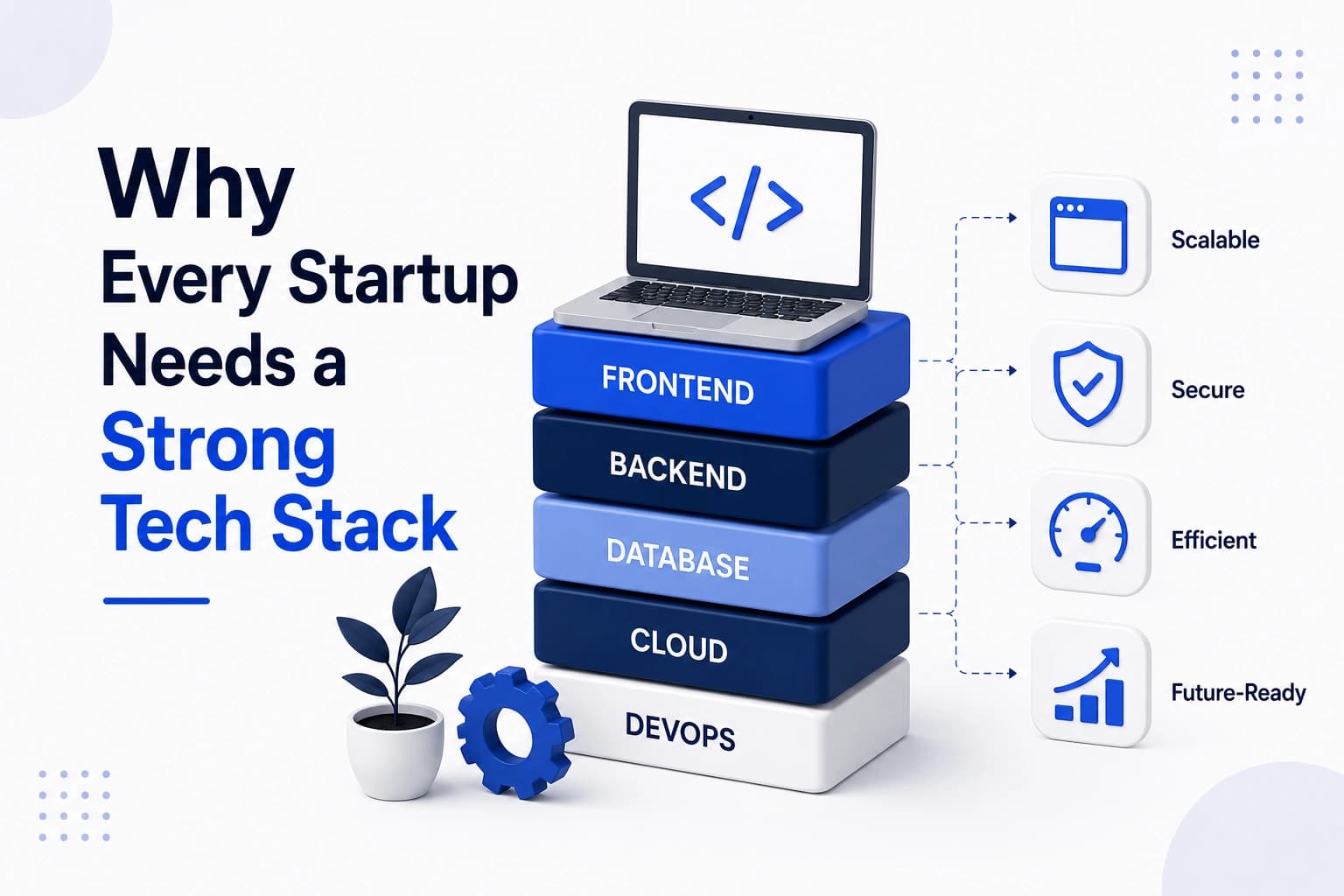
Key takeaway: A strong tech stack is critical because choosing the wrong architecture early on leads to crippling technical debt. Startups should optimize for hiring speed and developer experience by choosing boring, battle-tested technologies (like Postgres and React), start with monolithic structures rather than microservices, and decouple the frontend from the backend to ensure scalability without expensive rewrites.
Target Audience & Use Case: Ideal for technical founders, early-stage CTOs, and engineering leaders designing their MVP architecture or planning to scale their existing infrastructure.
A startup's tech stack is its digital foundation. When founders rush to build an MVP without considering their architecture, they accumulate technical debt that eventually brings feature development to a grinding halt. You don't want to rewrite your entire backend just when you finally find product-market fit.
As highlighted in StackShare's ecosystem reports, a strong tech stack isn't about chasing the latest shiny framework on Twitter; it's about choosing reliable, scalable, and developer-friendly tools. It is about the relentless drive to bring ideas to life without fighting your own infrastructure.
This guide breaks down how to make the right architectural choices across your application layer, databases, and DevOps to ensure your product scales smoothly in 2026.
Core Principles
Build for where you are
Don't over-engineer for a million users when you only have ten. Use battle-tested technologies that allow you to ship fast and iterate safely.
Hiring speed
Choose frameworks with massive communities. If you pick an obscure language, hiring developers to scale your team will become your biggest bottleneck.
Tech debt is inevitable
Accept that you will accumulate tech debt, but manage it wisely. Document hacks and schedule refactoring sprints before they cripple the codebase.
Application layer choices
Modern startups are heavily adopting the 'FANT' stack—FastAPI for blazing-fast, high-performance backends, Next.js for seamless React frontends, and TypeScript to catch critical errors before they hit production.
Alternatively, the battle-tested MERN stack (MongoDB, Express, React, Node.js) remains a highly reliable choice for JavaScript-heavy ecosystems where full-stack developers can move rapidly.
Keep your frontend decoupled from your backend. A strict API-first approach ensures you can swap out services later without rebuilding your UI.
Data and persistence
Choosing the right database prevents massive migration headaches later. Avoid storing highly relational data in document stores if complex queries are required.
Solutions like Supabase offer a powerful open-source Postgres alternative with built-in authentication and real-time subscriptions, perfect for rapid scaling.
Always separate your production database from your analytics database to prevent heavy queries from bringing down your live application.
Infrastructure and DevOps
Serverless architecture and platforms like Vercel or Render abstract away DevOps, allowing your team to focus strictly on shipping features rather than managing Linux boxes.
Implement Continuous Integration and Continuous Deployment (CI/CD) from day one. If a developer cannot push code to production with a single merge, your pipeline is too slow.
Use Infrastructure as Code (IaC) to version-control your cloud environments.
Security and compliance readiness
Don't roll your own crypto or authentication. Use established providers to handle passwords, MFA, and session management securely.
Implement Role-Based Access Control (RBAC) early. Retrofitting permissions into a massive app is a nightmare.
Store secrets and environment variables securely in encrypted vaults, never in your source code repository.
Developer experience
Developer Experience (DX) is a competitive advantage. If your local environment takes 3 hours to set up, you are burning expensive engineering time.
Enforce strict linting, formatting (Prettier), and typing (TypeScript). Consistent codebases are easier to read, maintain, and debug.
Write meaningful pull request descriptions and maintain a central technical wiki.
◆ Execution blueprint
Phased timeline to establish and audit your tech stack.
| Phase | Goal | Output | Timeline |
|---|---|---|---|
| Audit | Analyze current stack | Tech audit doc | Week 1 |
| Plan | Map out architecture | Architecture diagram | Week 2 |
| Implement | Set up CI/CD | Deployment pipeline | Week 3 |
| Migrate | Move data securely | Migration plan | Weeks 4-5 |
| Review | Monitor performance | Optimization report | Week 6 |
Reference table
| Component | Primary Focus |
|---|---|
| Frontend | User Experience & Speed |
| Backend | Business Logic & APIs |
| Database | Data Integrity & Scale |
| Infrastructure | Uptime & Scalability |
| CI/CD | Deployment Velocity |
Key points
- Choose boring, predictable technology over hype.
- FastAPI, Next.js, and Supabase offer massive leverage.
- TypeScript prevents thousands of runtime errors.
- Separate your frontend from your backend strictly.
- Never build your own authentication system.
- Automate deployments from the very first commit.
- Prioritize developer experience to ship faster.
- Relational databases are usually the safest default.
- Tech debt is fine if it buys you necessary speed.
- Optimize for hiring speed when choosing languages.
Action checklist
- Map out your entire tech stack visually
- Set up a CI/CD pipeline on GitHub Actions
- Configure staging and production environments
- Integrate a third-party Auth provider
- Enforce TypeScript across the codebase
- Set up Prettier and ESLint for consistency
- Document local setup steps in the README
- Audit database schemas for future scale
- Implement automated database backups
- Schedule a quarterly tech-debt review
Frequently asked questions
Quick answers to what founders usually ask about tech stacks.
What is the best tech stack for a startup MVP?
The best tech stack for an MVP is the one your founding team already knows. However, if you are starting fresh, the 'FANT' stack (FastAPI, Next.js, TypeScript) or the traditional MERN stack (MongoDB, Express, React, Node) provide incredible speed, large hiring pools, and massive ecosystem support.
The best tech stack for an MVP is the one your founding team already knows. However, if you are starting fresh, the 'FANT' stack (FastAPI, Next.js, TypeScript) or the traditional MERN stack (MongoDB, Express, React, Node) provide incredible speed, large hiring pools, and massive ecosystem support.
Should I use microservices for an MVP?
Absolutely not. Start with a monolithic architecture. Microservices introduce massive operational complexity, networking overhead, and deployment headaches. You can refactor into microservices later only when your team size and scaling requirements demand it.
What exactly is technical debt?
Technical debt is the implied cost of additional rework caused by choosing a fast, 'hacky' solution now instead of using a better approach that would take longer. Like financial debt, it incurs 'interest', making every future feature slower and harder to build until it is paid off (refactored).
Should we build custom Auth?
No. Authentication is a solved problem but highly catastrophic if done wrong. Use managed services like Supabase Auth, Clerk, or Auth0 to handle secure sessions, OAuth (Google/GitHub login), and password resets securely out-of-the-box.
How do we choose a database?
Default to a relational database like PostgreSQL unless your data is explicitly highly unstructured. Postgres is incredibly versatile, handles JSON well, and scales massively. Avoid NoSQL purely for 'speed of development' if your data naturally has relationships.
How to choose between AWS and Vercel for early startups?
Use platforms like Vercel, Render, or Supabase for speed. AWS provides ultimate control and scale, but the DevOps overhead is massive for a small team. Start with managed PaaS platforms to focus entirely on your product, then migrate to AWS later if unit economics demand it.
Can MYSTARTUPWAVE help rebuild our stack?
Yes. We conduct deep technical audits to identify bottlenecks and debt, map out a scalable modern architecture, and provide the engineering execution to migrate your platform safely without massive downtime.
Need implementation support?
MYSTARTUPWAVE helps founders and teams ship product, growth, and cloud delivery with clear milestones.